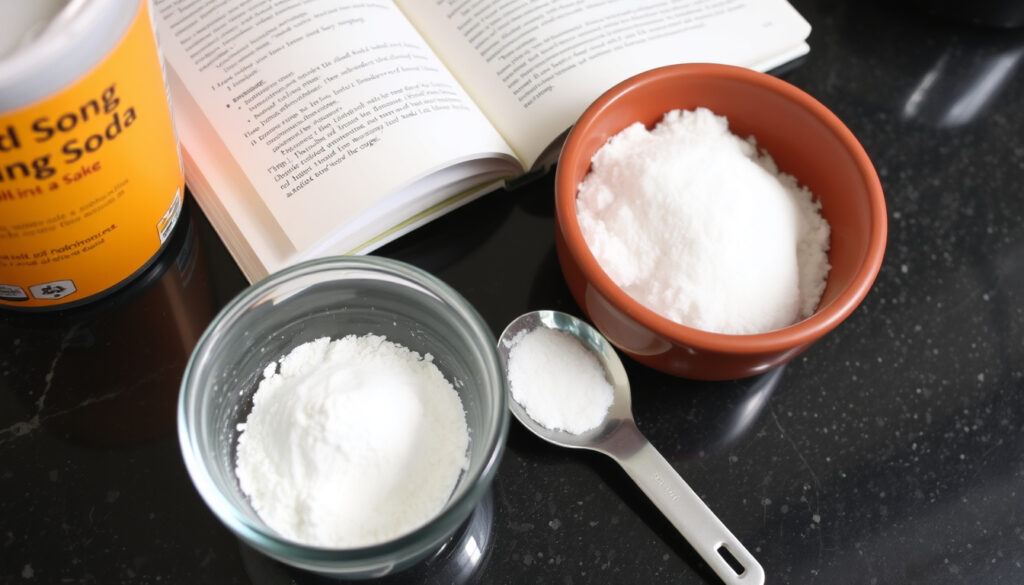
Is Baking Soda the Same as Bicarbonate of Soda? Complete Guide
If you’ve ever wondered whether bicarbonate of soda is the same as baking soda, the answer is yes—they are chemically identical. This guide explains the regional naming differences and how they differ from baking powder and soda crystals.
Chemical name: Sodium bicarbonate (NaHCO₃) ·
Common US term: Baking soda ·
Common UK / Ireland term: Bicarbonate of soda ·
Identical compound: 100% same chemical ·
Distinct from: Baking powder (contains acid)
Quick snapshot
- Baking soda and bicarbonate of soda are chemically identical — both are sodium bicarbonate (U.S. Food and Drug Administration).
- Baking powder contains sodium bicarbonate plus an acid and a starch (King Arthur Baking Company).
- Soda crystals are sodium carbonate, not sodium bicarbonate (Smol UK).
- Whether baking soda can permanently whiten yellow teeth — it removes surface stains but doesn’t change natural tooth colour.
- Long-term effects of daily bicarbonate of soda brushing are not well documented in dental literature.
- No critical timeline — the naming conventions between US, UK, and Ireland have been stable for decades, though online recipe searches continue to blur the lines.
- Expect more dental research on baking soda’s long-term enamel effects; consumer advocacy groups are pressing for clearer labelling in cleaning and personal care products (FDA).
Seven key properties separate the white powders on your shelf — one pattern: sodium bicarbonate may look similar to baking powder and soda crystals, but its chemical behaviour dictates entirely different roles.
| Property | Baking Soda / Bicarbonate of Soda | Baking Powder | Soda Crystals (Washing Soda) |
|---|---|---|---|
| Chemical formula | NaHCO₃ | NaHCO₃ + acid + starch | Na₂CO₃ |
| pH (1% solution) | 8.4 (slightly alkaline) | 7–8 (neutral) | 11 (strongly alkaline) |
| Common uses | Leavening agent, deodorizer, cleaning, toothpaste ingredient | Leavening agent in neutral batters | Heavy-duty cleaning, laundry, drain unblocking |
| Shelf life (unopened) | 2–3 years if stored dry | 1–2 years | Indefinite |
| Also known as | Sodium bicarbonate, bicarb, baking soda (US), bicarbonate of soda (UK/Ireland) | Baking powder | Washing soda, sodium carbonate |
| Taste | Slightly salty and bitter if used in excess | Neutral | Not for consumption |
| Reaction with acid | Releases CO₂ gas immediately when mixed with acid | Self-contained, reacts with liquid and heat | Effervesces with acid but not for baking |
| Strength vs. baking powder | 3–4 times stronger by weight | Weaker (used in larger quantities) | Much stronger alkaline, not for cooking |
Is baking soda the same as bicarbonate of soda?
Yes — and the chemistry leaves no room for doubt. Both names refer to pure sodium bicarbonate, a single compound with the formula NaHCO₃. The U.S. Food and Drug Administration lists sodium bicarbonate as the sole active ingredient in both products; no additives, no acids, no drying agents.
Why do the names differ?
The split is purely geographical. In the United States, the term baking soda dominates grocery shelves and recipe books. In the United Kingdom, Ireland, Australia, and New Zealand, bicarbonate of soda (often shortened to bicarb) is standard. Cook’s Illustrated confirms that the two phrases have been used interchangeably for over a century, with no chemical difference whatsoever.
How to identify sodium bicarbonate in ingredient lists
Whether you pick up a box labelled “baking soda” in a US supermarket or a pouch marked “bicarbonate of soda” at Dunnes Stores in Ireland, the ingredient list should read simply: “Sodium Bicarbonate.” If you see additional ingredients like cream of tartar or cornstarch, you are looking at baking powder — not pure bicarb.
Baking soda’s strength is both its asset and its risk. In the right proportion it lifts a buttermilk pancake to perfection; one teaspoon too much and your bake turns soapy. For Irish bakers, this means the 500g pack of Bicarbonate of Soda from Dunnes Stores works exactly the same as any US brand of baking soda — measure with care.
The implication: If a recipe written in US English calls for baking soda and you have bicarbonate of soda from Ireland, you have exactly the same ingredient. No conversion, no worry.
Is bicarbonate of soda the same as baking powder?
No — and confusing the two is the most common kitchen mistake in both the US and Ireland. Baking powder contains sodium bicarbonate, but it also packs its own acid and a starch filler, making it a self-contained leavening system.
Chemical differences between bicarbonate of soda and baking powder
King Arthur Baking Company explains that baking powder is sodium bicarbonate plus one or more acids (typically cream of tartar) and a starch to absorb moisture. This means baking powder does not need an acidic ingredient from your recipe to release carbon dioxide; it activates with liquid and heat. Single-acting powder fizzes when wet; double-acting releases a second burst in the oven.
When to use each in recipes
Use baking soda when your recipe includes a natural acid — buttermilk, yoghurt, lemon juice, vinegar, honey, or cocoa. The acid neutralises the soda’s alkaline taste and triggers the gas that makes cakes and cookies rise. Use baking powder when the batter is neutral, such as in many sponge cakes and scones. BBC Good Food advises that substituting one for the other requires careful adjustment: 1 teaspoon of baking powder equals about ¼ teaspoon of baking soda plus ½ teaspoon of an acid like lemon juice.
Baker’s rule: if you swap baking powder for baking soda without adding acid, your cake will be dense and may taste metallic. Conversely, using baking soda in a neutral batter leaves unreacted alkali that turns baked goods yellow and bitter. For Irish soda bread — which relies on buttermilk — bicarbonate of soda is the star; baking powder would be a pale substitute.
Why this matters: Choosing the wrong white powder changes your bake from tender to tough. The acid-content of your recipe dictates which one you need, not the country you buy it in.
What is baking soda called in Ireland?
In Ireland, the common term is bicarbonate of soda. You will find it on store shelves with that exact label — and it is the same sodium bicarbonate that Americans call baking soda.
Common Irish brand names (Dunnes Stores, Tesco, etc.)
Major Irish retailers label the product consistently. Dunnes Stores sells a 500g pack marked “Bicarbonate of Soda.” Tesco Ireland and SuperValu stock own-brand versions under the same name. The product is almost always found in the baking aisle, alongside flour and sugar, not in the cleaning section.
Shelf placement and terminology nationwide
Locals recognise “baking soda” as the American import term but rarely use it in everyday conversation. If you ask an Irish shop assistant for baking soda, they will likely point you to bicarbonate of soda — but showing the brand name “Dr. Oetker” or the generic label may help avoid confusion. Cook’s Illustrated notes that the Irish and UK nomenclature has been stable for generations, so there is no risk of the product being something else.
The pattern: For readers in Ireland, reach for “bicarbonate of soda” — it is the exact product you need, and you will pay the same price as the US version. No translation required.
Can I brush my teeth with bicarbonate of soda?
Many people turn to bicarbonate of soda as a cheap tooth-whitening hack. The short answer is yes — but with important caveats about frequency and enamel safety.
Safety of using bicarbonate of soda on teeth
Bicarbonate of soda is mildly abrasive. Occasional use (once a week) is generally considered safe, according to general dental practice. However, Dr. Amanda Patel, a general dentist quoted in dental hygiene literature, warns: “Occasional use is fine, but daily use may wear down enamel.” The UK National Health Service (NHS) oral health advice recommends limiting abrasive cleaning methods because enamel does not regrow. Mixing bicarbonate with regular toothpaste is common but not advised for long-term routines by most dental professionals.
Effectiveness for whitening yellow teeth
Bicarbonate of soda can help remove surface stains caused by coffee, tea, and tobacco. It cannot change the natural colour of your teeth. The evidence for true whitening is mixed — some studies show modest improvement over several weeks, but the effect varies by individual. For deeper whitening, dentist-supervised treatments remain the most reliable option.
The trade-off: You can brighten your smile on a budget, but the risk of thinning enamel over time means occasional use only. If yellow teeth are a persistent concern, a dental visit is a safer long-term investment.
Can I drink baking soda if I have high blood pressure?
Drinking baking soda — known as sodium bicarbonate — is sometimes promoted as a home remedy for indigestion or athletic performance. For anyone with high blood pressure, this practice carries real risks.
Sodium content in baking soda and its effect on blood pressure
One teaspoon of baking soda contains about 1,200 mg of sodium — more than half the American Heart Association’s daily recommended limit of 2,300 mg for most adults. High sodium intake is a well-established contributor to elevated blood pressure, especially in people already diagnosed with hypertension. Consuming baking soda internally adds a large sodium load that can cause fluid retention and increase cardiovascular strain.
Medical guidance on internal use of sodium bicarbonate
The FDA classifies sodium bicarbonate as generally safe for food use in small amounts, but advises against using it as a drug without medical supervision. If you have high blood pressure, kidney disease, or are on a low-sodium diet, do not drink baking soda. Even for healthy individuals, chronic ingestion can disrupt electrolyte balance. Always consult a doctor before using any food ingredient as a remedy.
What this means: The risk outweighs any perceived benefit for those with hypertension. One teaspoon contains as much sodium as half a day’s allowance — far too high for safe self-experimentation.
Is baking soda the same as soda crystals?
No. This is a common confusion, especially in cleaning contexts. Soda crystals (washing soda) are sodium carbonate (Na₂CO₃), a different and much stronger alkaline compound.
Chemical composition of soda crystals
Sodium carbonate has a pH of about 11 (compared to baking soda’s 8.4). It is caustic enough to break down grease, remove wax, and soften laundry water — but it is not safe for cooking or personal care. Smol UK explains that soda crystals are used in heavy-duty cleaning and are not interchangeable with baking soda for any food-related task.
Key differences in cleaning applications
Baking soda is a mild abrasive and deodoriser — excellent for scrubbing sinks, absorbing fridge smells, and gentle cleaning. Soda crystals are for tough jobs: removing baked-on oven grime, unblocking drains, and boosting laundry detergent. Using soda crystals where baking soda is called for can damage surfaces and cause skin irritation. And vice versa — using baking soda where soda crystals are needed will simply not be strong enough.
The pattern: One is a gentle kitchen helper; the other is a heavy-duty cleaner. Never put soda crystals in your food or on your toothbrush — only baking soda (bicarbonate of soda) belongs in the kitchen and bathroom cabinet for safe daily use.
Confirmed facts
- Baking soda and bicarbonate of soda are chemically identical sodium bicarbonate (FDA).
- Baking powder contains an acid and does not need acidic ingredients to react (King Arthur Baking).
- Ingesting large amounts of baking soda can raise blood pressure due to high sodium content (American Heart Association).
- Bicarbonate of soda is safe for occasional tooth brushing but can be abrasive (Dr. Amanda Patel / NHS).
- Soda crystals are sodium carbonate, not sodium bicarbonate (Smol UK).
What’s unclear
- Effectiveness of baking soda for whitening yellow teeth varies — removes surface stains but does not change natural tooth colour.
- Long-term effects of daily bicarbonate of soda brushing are not well documented in dental literature.
Occasional use is fine, but daily use may wear down enamel.
— Dr. Amanda Patel, general dentist, commenting on tooth brushing with baking soda
The NHS (UK National Health Service) advises limiting abrasive cleaning methods to avoid irreversible enamel loss.
— NHS oral health guidance
The American Heart Association (AHA) recommends no more than 2,300 mg of sodium per day for most adults — one teaspoon of baking soda provides over half that limit.
— American Heart Association dietary sodium guidelines
For anyone standing in a Dublin kitchen with a box labelled “bicarbonate of soda” and a US recipe calling for “baking soda,” the choice is simple: use it exactly as written. The real distinction lies between this single white powder and its close cousins — baking powder and soda crystals — each with its own chemistry and consequences. For Irish shoppers, the implication is clear: buy the 500g pack of Bicarbonate of Soda from Dunnes Stores for baking, cleaning, and occasional dental care, but steer clear of soda crystals for any recipe or personal use.
kempii.co.uk, earthconscious.co.uk, littleaussie.com.au, ishtarcompany.com
Frequently asked questions
Can I use bicarbonate of soda instead of baking soda in recipes?
Yes — they are the same chemical. Use the exact amount called for in the recipe.
Is baking soda the same as bicarbonate of soda for cleaning?
Yes. Both are sodium bicarbonate and work identically for cleaning and deodorising.
Does bicarbonate of soda expire?
It does not spoil, but it can lose potency over time. Test by adding a splash of vinegar — if it fizzes vigorously, it is still active.
Can bicarbonate of soda lighten yellow teeth?
It can remove surface stains from coffee and tea, but it does not change the natural colour of your teeth. Results vary.
Where can I buy bicarbonate of soda in Ireland?
Major supermarkets including Dunnes Stores, Tesco Ireland, SuperValu, and local grocers stock it in the baking aisle.
Can I mix bicarbonate of soda with toothpaste?
Occasional mixing is common but not recommended long-term by dentists due to abrasiveness. Limit to once a week.
Related reading
- Irish Soda Bread Recipe — a traditional loaf that relies on bicarbonate of soda as its leavening agent.
- How to Clean Stainless Appliances: Streak-Free Guide — practical cleaning tips using baking soda.
More related posts
 Armani Luminous Silk Foundation – Shades Reviews and Guide
 Galway Family Planning Clinic – Services & Free Contraception
 Pamela Scott Online Sale Ireland: Best Deals & Stores
 Drive to Survive Season 7: Release Date, Episodes & Future
 Meliá Jardines del Teide: Reviews, All Inclusive & Level
 Today’s Horse Racing Results: UK, Ireland & Fast Updates
 TUD Calendar 2025/26: TU Dublin PDF, Dates & Timetables
 Who Got Eliminated from I’m a Celebrity? Latest Evictions