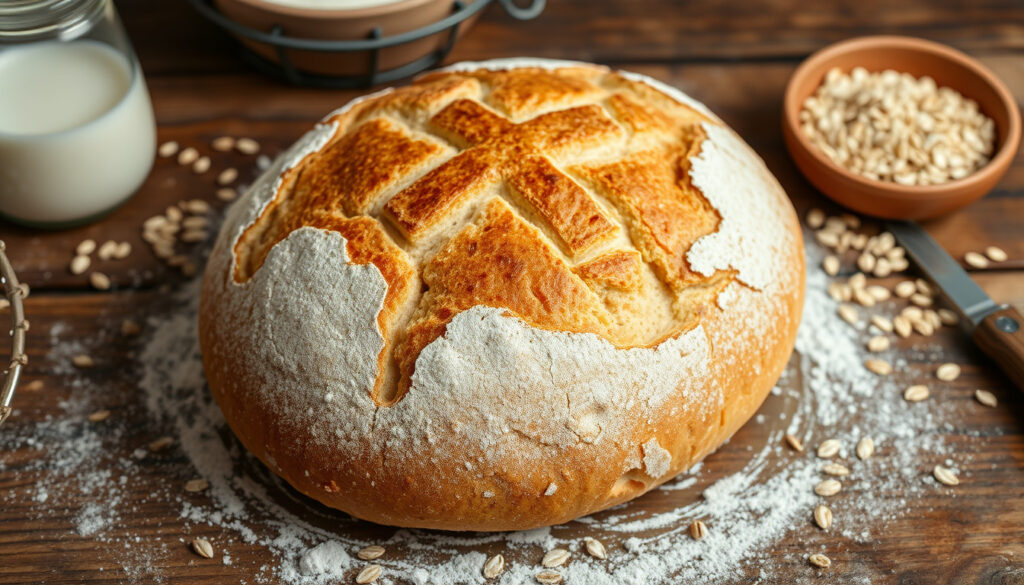
Irish Soda Bread Recipe: Traditional, Simple & Best (No Yeast)
If you’ve ever grabbed a loaf from the bakery counter and wondered why it crumbled differently than your standard sandwich bread, Irish soda bread is probably why. This quick bread relies on a chemical reaction between baking soda and buttermilk instead of yeast, which means no kneading, no proving, and no waiting around for dough to rise. The result is a tender loaf with a crackly crust that pairs beautifully with butter, cheese, or a hearty bowl of soup.
Prep Time: 10 minutes · Bake Time: 45-50 minutes · Servings: 12 · Key Leavener: Baking soda · Yeast Required: No
Quick snapshot
- No yeast in traditional recipes (Busy Creating Memories)
- Leavening comes from bicarbonate of soda reacting with buttermilk acidity (Busy Creating Memories)
- Mary Berry’s recipe uses 450g flour, 1 tsp baking soda, 1 tsp salt, 300ml buttermilk (The Happy Foodie)
- Exact regional variants between Ulster and Southern Irish traditions
- Precise publication date of Mary Berry’s original recipe
- 19th century: soda bread popularized with baking soda availability in Ireland (Quicktime Recipes)
- Total bake time: 30-40 minutes at 200°C (The Happy Foodie)
- Follow step-by-step recipe with expert tips
- Explore variations including Mary Berry, Paul Hollywood, and brown soda bread
The table below summarizes key specifications across the most-referenced soda bread recipes from professional and home-baking sources.
| Label | Value |
|---|---|
| Origin | Ireland |
| Leavening Agent | Baking soda |
| Key Ingredient | Buttermilk |
| Yeast Needed | No |
| Typical Prep | 10 minutes |
| Oven Temperature | 200°C (fan 180°C) |
| Typical Bake Time | 30-40 minutes |
| Best Eaten | Fresh same day |
What is the traditional Irish soda bread recipe with buttermilk?
The traditional Irish soda bread recipe is refreshingly simple: flour, salt, buttermilk, and bicarbonate of soda. That’s it—no yeast, no kneading, no bread flour required. Mary Berry’s version calls for 450g strong white flour, 1 tsp bicarbonate of soda, 1 tsp salt, and 300ml buttermilk, which produces a soft, slightly tangy loaf that bakes in under an hour from start to finish.
Ingredients for traditional version
- 450g strong white flour (plain all-purpose works fine)
- 1 tsp bicarbonate of soda (baking soda)
- 1 tsp salt
- 300ml buttermilk (measured range: 300-500ml depending on flour weight)
- 1 tsp sugar (optional, for slight sweetness)
Step-by-step baking instructions
- Preheat oven to 200°C (fan 180°C, gas mark 6). Place a baking tray in the oven to heat up.
- Mix dry ingredients in a large bowl: flour, bicarbonate of soda, and salt.
- Add buttermilk and stir until a soft, shaggy dough forms. The dough should be sticky—don’t overmix.
- Turn onto a lightly floured surface. Gently shape into a round loaf without kneading.
- Score a deep cross on top, cutting into quarters without cutting fully through the base.
- Transfer to the preheated baking tray and bake for 30-40 minutes until golden and hollow-sounding when tapped underneath.
- Cool on a wire rack. Best eaten fresh the same day.
Tips for perfect crust
The cross cut is traditional and functional—it allows heat to reach the center of the dense loaf and prevents the crust from cracking unpredictably. For an extra-crackly crust, some bakers add cold butter pieces to the dough for scone-like texture, or replace 50g flour with porridge oats for added nuttiness.
Soda bread dough should remain soft and sticky. Overmixing develops gluten and makes the bread tough. Resist the urge to add more flour—just work quickly and gently.
What is Mary Berry’s soda bread recipe?
Mary Berry’s Irish soda bread is a staple recipe that has appeared in British baking collections for years. Her version emphasizes simplicity: bicarbonate of soda reacts with the acidity of buttermilk (or a milk-yoghurt blend) to create air bubbles and a gentle rise without any yeast. She calls it a “must-try staple bread” that comes together in about 10 minutes of hands-on work.
Mary Berry ingredients list
- 450g strong white flour
- 1 tsp bicarbonate of soda
- 1 tsp salt
- 300ml buttermilk (or a mix of milk and yoghurt)
- Optional: 1 tsp sugar for slight sweetness
Baking method
The Happy Foodie (which hosts Mary Berry’s official recipe) specifies baking at 200°C/fan 180°C/gas 6 for 30-40 minutes. Mary Berry’s recipe allows adding tepid water if the dough feels too stiff, though the consistency should remain tacky rather than wet.
Variations
For texture variation, replace 50g of the flour with porridge oats—this adds a nutty flavor and slightly denser crumb. The bread stays fresh for one day but makes excellent toast the following morning.
Mary Berry’s recipe works equally well with yoghurt-thinned milk or full buttermilk. The exact acidity matters more than the label—skipping the acid component entirely results in a flat, dense loaf.
What is the best Irish soda bread recipe?
The “best” recipe depends on your priorities: traditional authenticity, simplicity, or flavor complexity. Several highly-rated recipes from food bloggers and celebrity bakers offer proven results. Sally’s Baking Addiction notes that soda bread dough comes together in about 10 minutes, while Alexandra Cooks describes a 5-minute stir-together process for absolute beginners.
Top-rated ingredient ratios
- Paul Hollywood: 250g white flour + 250g wholemeal flour, 1 tsp salt, 1 tsp bicarbonate of soda, 500ml buttermilk
- Busy Creating Memories: 500g flour, 400ml buttermilk, explicit 5-minute prep time
- The Simpler Kitchen: 2 cups white + 2 cups wholemeal, 1.5 tsp salt, 1.5 tsp baking soda, 1 2/3 cups buttermilk
Each recipe shifts flour weight and liquid volume slightly, creating a spectrum from light and airy to hearty and dense.
Recipe comparison matrix
| Chef/Source | White Flour | Wholemeal | Buttermilk | Bake Temp | Time |
|---|---|---|---|---|---|
| Mary Berry | 450g | — | 300ml | 200°C | 30-40 min |
| Paul Hollywood | 250g | 250g | 500ml | 200°C | 35-40 min |
| Busy Creating Memories | 500g | — | 400ml | 200°C | 30-40 min |
| The Simpler Kitchen | 2 cups | 2 cups | 1 2/3 cups | 200°C | 30-40 min |
The pattern across sources shows 200°C as the consensus oven temperature, with bake times clustering tightly between 30-40 minutes regardless of flour composition.
Reader-tested adjustments
For extra lift, add 1 tsp baking powder alongside the baking soda. For a richer loaf, crack an egg into the buttermilk before mixing. These small additions can shift the crumb from compact to open and airy without changing the fundamental method.
Oven temperatures vary between recipes (200°C standard vs. 220°C copycat versions). If your loaf seems to be browning too quickly before the center cooks through, tent it loosely with foil for the final 10 minutes.
What is a simple Irish soda bread recipe?
For beginners, the simplest version uses just four ingredients: flour, salt, baking soda, and buttermilk. No bread flour needed—plain all-purpose works perfectly. Total hands-on time is about 5 minutes, with 30-40 minutes in the oven. It’s ideal for empty bread bin emergencies and requires no proving time at all.
Minimal ingredients
- 350g plain flour (no special bread flour required)
- 1 tsp salt
- 1 tsp bicarbonate of soda
- 300ml buttermilk
Easy no-knead steps
- Preheat oven to 200°C.
- Combine dry ingredients in a bowl.
- Pour in buttermilk, stir briefly until just combined.
- Shape into a round loaf on a baking tray.
- Cut a deep cross on top.
- Bake 30-40 minutes until hollow-sounding.
Beginner tips
Use a food scale for flour accuracy—this matters more than the specific brand. The dough should be shaggy and slightly sticky; add tepid water by the tablespoon if it’s too thick. Do not knead the dough; folding gently to shape is sufficient.
Beginner-friendly simplicity means forgiving technique—butter amounts, mixing time, and rest periods won’t make or break the recipe the way they would with yeast bread.
What is Irish brown soda bread recipe?
Brown soda bread uses wholemeal flour instead of or alongside white flour, creating a denser, more nutritious loaf with a nutty, earthy flavor. Paul Hollywood’s version splits the flour 50/50 between white and wholemeal, while traditional Irish recipes sometimes use all wholemeal for a darker, heartier result.
Wholemeal flour differences
Wholemeal flour absorbs more liquid than white flour, so recipes typically increase buttermilk by 10-15%. Paul Hollywood’s recipe calls for 250g white + 250g wholemeal with 500ml buttermilk. The higher bran content creates a tighter crumb but more rustic texture.
Recipe steps
- Mix 250g wholemeal flour, 250g white flour, 1 tsp salt, and 1 tsp bicarbonate of soda.
- Add 500ml buttermilk and stir until a soft dough forms.
- Shape into a round loaf.
- Score a deep cross.
- Bake at 200°C for 35-40 minutes.
Texture expectations
Expect a denser, more compact crumb than white soda bread. The crust stays just as crackly, and the flavor is more robust—excellent for soups and stews. Best eaten the same day, though it toasts well into a hearty breakfast slice.
Brown soda bread is more traditional in rural Ireland than the white version, yet many home bakers assume white flour is the default. The heartier wholemeal variant deserves attention for anyone seeking authenticity.
The implication: choosing wholemeal shifts both texture and cultural authenticity—bakers who want the genuine article should reach for the darker flour.
How to make Irish soda bread
Three respected recipes—Mary Berry’s, Paul Hollywood’s, and a simple beginner version—share the same core technique with different flour-to-buttermilk ratios.
Ingredients
- 450-500g plain white flour (or 250g white + 250g wholemeal for brown version)
- 1 tsp bicarbonate of soda (baking soda)
- 1 tsp salt
- 300-500ml buttermilk (scaled to flour amount)
- Optional: 1 tsp sugar, cold butter pieces, or porridge oats
Instructions
- Preheat oven to 200°C (fan 180°C). Place a baking tray inside to heat.
- Mix dry ingredients thoroughly in a large bowl—uniform distribution ensures even leavening.
- Add buttermilk and stir until a soft, sticky dough forms. Do not overmix.
- Shape gently into a round loaf on a lightly floured surface. No kneading required.
- Score a deep cross on top, cutting into quarters without severing the base.
- Bake on the preheated tray for 30-40 minutes until golden and hollow when tapped underneath.
- Cool on a wire rack. Serve warm with butter.
What experts say
A classic Irish bread from Mary Berry. This inspired recipe is a must-try staple bread which combines bicarbonate of soda with yoghurt, milk and buttermilk.
— Mary Berry, via The Happy Foodie
You need this soda bread in your life—right now. It’s my go-to recipe: simple, foolproof, and straight from Mary Berry, the queen herself.
— Quicktime Recipes Author, via Quicktime Recipes
This easy traditional Irish soda bread recipe delivers golden-brown perfection every time.
— Busy Creating Memories (detailed traditional method and tips)
Paul Hollywood’s Soda Bread is a fantastic homemade crusty bread with no yeast, no kneading.
— My Gorgeous Recipes (traditional no-yeast recipe source)
Irish soda bread proves that remarkable bread doesn’t require complexity. The chemical leavening reaction between baking soda and buttermilk—documented across multiple recipe sources since the 19th century—produces a tender crumb and crackly crust in under an hour with zero kneading. Whether you follow Mary Berry’s exact measurements (450g flour, 1 tsp baking soda, 300ml buttermilk) or Paul Hollywood’s heartier wholemeal variation (250g white + 250g wholemeal, 500ml buttermilk), the principle remains identical: soft, sticky dough, deep cross on top, and a hot oven.
Related reading: Mary Berry’s Irish Soda Bread · Easy Irish Soda Bread Recipe
For those exploring brown soda bread variations, this simple brown bread recipe offers a wholesome wholemeal loaf with the same no-yeast simplicity.
Frequently asked questions
How long does Irish soda bread keep?
Soda bread is best eaten fresh on the day of baking. It stays edible for 1-2 days stored in a bread bag at room temperature, though the crust softens. The Simpler Kitchen notes it makes excellent toast the next day.
Can I substitute yogurt for buttermilk?
Yes. Mix milk with lemon juice, vinegar, or yoghurt to mimic buttermilk’s acidity—the chemical reaction with baking soda depends on that acidity. Full-fat yoghurt tends to produce the most consistent results.
Why does Irish soda bread have a cross on top?
The cross serves a practical purpose: it allows heat to penetrate the dense center during baking and prevents the crust from cracking unpredictably. It also traditionally signifies blessing the bread.
Is Irish soda bread vegan?
Traditional versions are not vegan due to buttermilk. However, plant-based milk + lemon juice works as a substitute, creating the necessary acidity for the baking soda reaction. The loaf won’t be identical but will rise acceptably.
What if my soda bread is too dense?
Dense bread typically results from inadequate acidity (not enough buttermilk or substitute) or expired baking soda. Ensure your bicarbonate of soda is fresh—old leavener won’t produce enough gas. Also avoid overmixing the dough.
Can I freeze Irish soda bread?
Yes. Wrap tightly in plastic wrap and freeze the same day. Thaw at room temperature or reheat in a 180°C oven for 10-15 minutes. Quality is best from fresh baking, but frozen storage extends usability by 1-2 months.
Does Irish soda bread need to rise?
No. Unlike yeast breads, soda bread skips the proving step entirely. The chemical reaction between baking soda and buttermilk happens in the hot oven, creating air bubbles during baking rather than before.
More related posts
 Seafield Hotel & Spa Resort: Location, Rating, and Activities
 Mother’s Day 2025 in Poland: Date, History & Ideas
 Munster v La Rochelle TV: Channel, Stream & Kick-Off Time
 Peter McVerry Trust Secret Fees: Controversy & Deals
 Armani Luminous Silk Foundation – Shades Reviews and Guide
 National Maternity Hospital Dublin: History & Relocation
 De Longhi Coffee Machine: Use, Clean & Ireland Guide
 Improve Your Posture: Best Exercises, Sports & Timelines