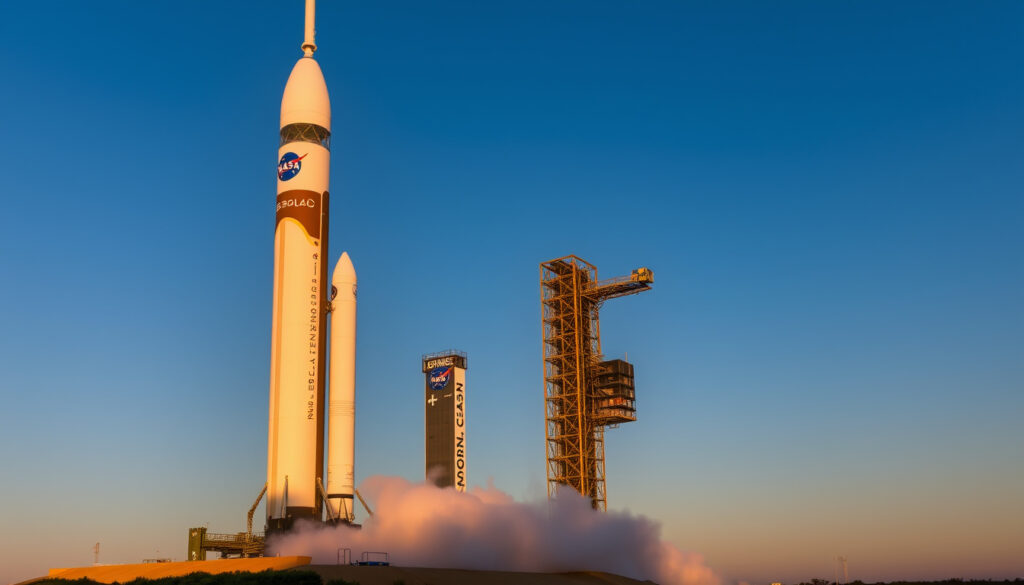
NASA Artemis Rocket Launch – Schedule, Live Stream and Expectations
NASA Artemis Rocket Launch: Complete Guide to America’s Return to the Moon
NASA’s Artemis program represents humanity’s most ambitious lunar exploration endeavor in more than half a century. The program, named after Apollo’s twin sister in Greek mythology, aims to establish a sustainable human presence on the Moon and pave the way for future Mars missions. The successful launch of the Space Launch System (SLS) rocket and Orion spacecraft marked a pivotal moment in space exploration history, reigniting public fascination with lunar discovery and demonstrating renewed international commitment to deep space exploration.
The Artemis I mission, launched in November 2022, completed an uncrewed flight test that sent the Orion spacecraft around the Moon and back to Earth. This critical milestone validated the vehicle systems and prepared the way for subsequent crewed missions. The program builds upon decades of technological advancement and lessons learned from the International Space Station, commercial space partnerships, and previous lunar missions, positioning NASA to return astronauts to the lunar surface for the first time since the Apollo 17 mission in 1972.
Artemis Mission Architecture Overview
The Artemis program comprises multiple integrated elements designed to achieve sustainable lunar exploration. The Space Launch System serves as the primary heavy-lift launch vehicle, capable of placing more than 27 metric tons toward the Moon. The Orion spacecraft provides crew transportation and life support systems for extended deep space missions. Gateway, the lunar orbiting outpost, will enable regular access to the lunar surface and serve as a staging point for exploration activities.
Human landing systems developed through commercial partnerships will transport astronauts from lunar orbit to the surface and back. The program also incorporates advanced robotics, in-situ resource utilization technologies, and habitat modules designed to support extended stays on the Moon. International cooperation plays a central role, with contributions from the European Space Agency, Japan Aerospace Exploration Agency, and Canadian Space Agency enhancing mission capabilities and shared scientific objectives.
Key Mission Objectives
- Establish sustainable human presence on and around the Moon by the end of the decade
- Demonstrate technologies for future Mars missions including life support, power systems, and surface operations
- Conduct extensive scientific research on lunar geology, resources, and the space environment
- Inspire global collaboration in space exploration and engage new generations in STEM fields
- Explore potential resources including water ice deposits that could support future human activities
Space Launch System: Engineering Marvel
The Space Launch System represents NASA’s most powerful rocket since the Saturn V that carried Apollo astronauts to the Moon. Standing 322 feet tall with the Orion spacecraft atop, the SLS generates 8.8 million pounds of thrust at liftoff, exceeding the thrust of the Saturn V by 15 percent. The core stage, powered by four RS-25 engines derived from the Space Shuttle program, works in conjunction with twin solid rocket boosters to achieve the necessary velocity for lunar trajectories.
Engineers incorporated advanced manufacturing techniques and materials throughout the vehicle’s development. The core stage’s liquid hydrogen tank, constructed from aluminum-lithium alloy, represents the largest such tank ever built for a rocket. Additive manufacturing played a significant role in producing complex components while reducing weight and production time. The vehicle’s avionics system utilizes modern computing architecture while maintaining the reliability standards essential for human spaceflight.
The Block 1 configuration used for Artemis I will evolve through subsequent iterations. Block 1B, featuring the Exploration Upper Stage, will increase payload capacity and enable more efficient lunar missions. Block 2, the final configuration, will incorporate advanced boosters and deliver more than 46 metric tons to lunar orbit, supporting sustained surface operations and potentially enabling crewed missions to Mars in subsequent decades.
Orion Spacecraft Capabilities
The Orion spacecraft represents the crew transportation system designed for deep space missions extending far beyond low Earth orbit. The crew module, with a volume of 690 cubic feet, provides living space for up to four astronauts on lunar missions—significantly more cramped than the International Space Station but adequate for missions lasting three weeks or less. Advanced life support systems recycle air and water, enabling the extended autonomous operations necessary for lunar distance travel.
Thermal protection during Earth reentry presents one of the spacecraft’s most demanding engineering challenges. The ablative heat shield, manufactured from 16,000 individual tiles of material derived from the Apollo era, must withstand temperatures reaching 5,000 degrees Fahrenheit while protecting the spacecraft and its contents. The飞船’s parachute system deploys in a precisely choreographed sequence to slow the vehicle from hypersonic velocities to gentle splashdown in the Pacific Ocean.
Mission communications rely on NASA’s Deep Space Network augmented by additional ground stations and relay satellites. The spacecraft carries an innovative emergency abort system capable of pulling the crew module to safety in the event of a launch vehicle failure during the most critical phases of ascent. Extensive sensor arrays throughout the vehicle record structural loads, thermal conditions, and system performance, providing invaluable data for future mission refinement.
Artemis Mission Timeline
| Mission | Target Date | Objectives | Crew Status |
|---|---|---|---|
| Artemis I | November 2022 | Uncrewed flight test, lunar orbit validation | Uncrewed |
| Artemis II | September 2025 | Crewed flyby of the Moon, systems verification | 4 astronauts |
| Artemis III | September 2026 | First crewed lunar landing since 1972 | 4 astronauts (2 to surface) |
| Artemis IV | 2028 | Gateway assembly and initial surface missions | 4 astronauts |
Artemis I successfully launched on November 16, 2022, after multiple delays due to technical issues and hurricane impacts. The mission lasted 25 days, with Orion traveling more than 1.4 million miles and completing two close lunar flybys before returning to Earth. The spacecraft performed within acceptable parameters across all major systems, though some minor anomalies provided engineering teams with valuable data for optimization.
Artemis II, originally scheduled for 2024, represents the first crewed flight of the Orion spacecraft. Four astronauts will conduct a free-return trajectory around the Moon, testing life support systems, navigation procedures, and operational protocols in the deep space environment. The mission will validate crew interfaces and communication systems while building confidence in vehicle performance with humans aboard.
Artemis III will achieve the program’s primary objective of landing astronauts on the lunar surface. The mission architecture relies on SpaceX’s Starship human landing system, which will rendezvous with Orion in lunar orbit before transporting two astronauts to the south polar region. The landing site selection prioritizes areas with evidence of water ice deposits and scientifically significant geological features.
Understanding the Artemis Program’s Significance
The Artemis program carries implications extending far beyond the technical achievement of returning humans to the Moon. Scientific investigations conducted during surface operations will address fundamental questions about the Moon’s formation and evolution, the history of the solar system, and the effects of long-duration space exposure on human physiology. Geological sampling from previously unexplored regions may yield discoveries with implications for planetary science broadly.
Economic considerations also drive program motivation. The emerging cislunar economy, encompassing satellite servicing, manufacturing, tourism, and resource extraction, represents a potential multi-trillion-dollar market in coming decades. By establishing infrastructure and operational experience in the lunar environment, NASA positions the United States and its partners to participate in this economic development rather than observe from Earth.
The program serves diplomatic and strategic objectives as well. The Artemis Accords, signed by more than 30 nations, establish principles for peaceful lunar cooperation including transparency, interoperability, and utilization of space resources in accordance with the Outer Space Treaty. These agreements foster international collaboration while promoting American leadership in setting norms for space activities.
Technical Challenges and Solutions
Developing systems for sustained lunar presence presents engineering challenges not encountered in low Earth orbit operations. Communications delays of up to 1.3 seconds each way require astronauts to operate with greater autonomy than ISS crews, making independent decisions without real-time ground support. Radiation exposure beyond Earth’s protective magnetosphere demands enhanced shielding and medical monitoring protocols to safeguard crew health during extended missions.
Lunar dust, known as regolith, presents operational difficulties for equipment and human health alike. The abrasive particles cling to surfaces, degrade seals, and pose respiratory concerns when tracked into habitat modules. Engineers developed specialized airlocks, filtration systems, and dust-resistant coatings to mitigate these effects. Surface mobility systems must navigate terrain that varies from ancient lava plains to crater rims with slopes approaching 25 degrees.
Power generation in the lunar environment requires solutions adapted to 14-day nights and the need for continuous operation. Solar arrays must incorporate mechanisms to handle thermal extremes while providing sufficient energy storage for darkness periods. The initial surface missions will utilize NASA’s Human Landing System and support infrastructure to provide reliable power throughout crew activities.
Expert Perspectives on Lunar Return
“Artemis represents not merely a return to the Moon but a fundamentally different approach to lunar exploration—one focused on sustainability, international partnership, and using what we learn there to reach even farther into the solar system.”
— NASA Administrator, Press Conference, November 2022
Space industry analysts note that the commercial partnerships integral to Artemis reflect broader shifts in how governments approach major infrastructure projects. By leveraging private sector innovation and competition, NASA reduces development costs while stimulating economic growth in the emerging space sector. Companies including SpaceX, Blue Origin, and numerous small businesses have developed capabilities that may serve future exploration needs.
Scientific community enthusiasm focuses on the research opportunities unique to lunar exploration. The Moon’s south polar region contains permanently shadowed craters where water ice has accumulated over billions of years, potentially preserving organic compounds and offering insights into early solar system chemistry. Astronauts will conduct field geology, deploy instruments, and return samples using techniques refined during Apollo but adapted for modern scientific priorities.
International partners bring capabilities that enhance overall program value. ESA provides the European Service Module powering Orion and communication equipment for Gateway. JAXA contributes habitation modules and rovers designed for lunar surface operations. CSA supplies advanced robotics including the Canadarm3 robotic system for Gateway maintenance. This distributed approach spreads risk while building political support for sustained exploration commitment.
What Lies Ahead for Artemis
The Artemis program charts a course toward indefinite human presence beyond Earth, with the Moon serving as a proving ground for Mars-bound capabilities. Each mission builds upon predecessors, gradually expanding operational range, crew duration, and surface exploration capability. By the end of the decade, the architecture should support regular crew rotations and extended surface stays, enabling continuous scientific investigation and commercial activity.
Private sector interest in lunar activities continues accelerating, with multiple companies announcing plans for commercial missions in support of or independent from NASA’s timelines. This growing ecosystem of lunar service providers promises to reduce costs and expand access over time, potentially enabling activities currently unimaginable. Education and inspiration remain central program benefits, with Artemis serving as a touchstone for STEM engagement worldwide.
The journey back to the Moon, now well underway, represents a milestone in human spaceflight that will define the coming decades of exploration. Success will depend not only on technical achievement but on sustained political will, international cooperation, and the ability to translate exploration investments into broader societal benefits. The Artemis generation may witness achievements that reshape our understanding of humanity’s place in the cosmos.
Frequently Asked Questions
When did the Artemis I launch occur?
Artemis I launched on November 16, 2022, at 1:47 AM EST from Kennedy Space Center Launch Complex 39B. The mission concluded on December 11, 2022, with the successful splashdown of the Orion spacecraft in the Pacific Ocean after traveling more than 1.4 million miles on its journey around the Moon.
When is the first crewed Artemis landing planned?
Artemis III, which will achieve the first crewed lunar landing since Apollo 17 in December 1972, is currently scheduled for September 2026. This mission will land two astronauts near the lunar south pole using SpaceX’s Starship human landing system.
What is the difference between Artemis and Apollo programs?
While both programs aim to land humans on the Moon, Artemis differs fundamentally in approach. Apollo represented a short-term political competition, while Artemis pursues sustainable presence with reusable systems, international partnerships, commercial participation, and the goal of using lunar experience to enable Mars missions. Artemis also emphasizes exploration of previously unvisited regions and permanent infrastructure development.
How powerful is the Space Launch System rocket?
The Space Launch System generates 8.8 million pounds of thrust at liftoff, making it 15 percent more powerful than the Saturn V rocket used for Apollo missions. The rocket stands 322 feet tall and can place more than 27 metric tons of payload on a trajectory toward the Moon in its initial Block 1 configuration.
How long does it take to travel to the Moon?
The journey to the Moon takes approximately three days using current technology. Artemis missions will spend about a week in lunar orbit conducting operations before beginning the three-day return journey to Earth. Total mission duration for Artemis I was 25 days, with subsequent crewed missions expected to last 10 to 30 days depending on specific objectives.
Which countries are participating in the Artemis program?
More than 30 nations have signed the Artemis Accords, establishing principles for peaceful lunar cooperation. Major international partners include the European Space Agency, Japan Aerospace Exploration Agency, and Canadian Space Agency, which contribute hardware and capabilities to various program elements including the Gateway outpost and Orion spacecraft.
More related posts
 Gluten Free Near Me: Best Restaurants & Fast Food in Ireland
 Welfare Payment Boost Budget 2026: Dates & Increases
 EastEnders Spoilers Next Week: Exits, Pregnancies & Wig Drama
 House for Sale Mayo: Find Bargains, Cottages & Land
 Specsavers Eye Test Cost 2025: Prices, Free Options, Offers
 Sorra Daurada Splash Hotel: Beach, All-Inclusive, Cleanliness
 Where to Find Cheap Baby Items in Ireland: Budget Guide
 Today’s Horse Racing Results: UK, Ireland & Fast Updates