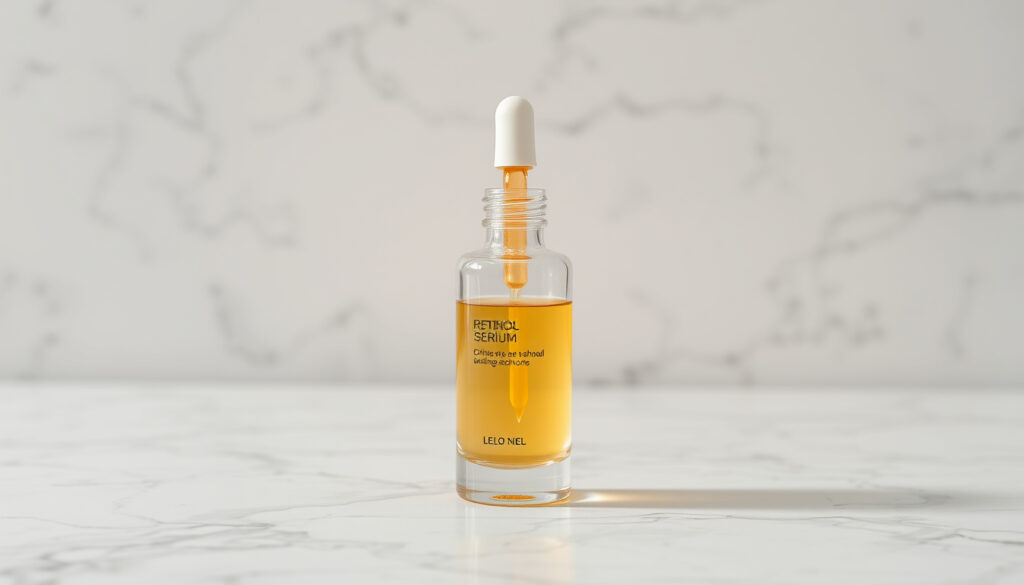
What Does Retinol Do? Benefits, Uses & Side Effects
Dermatologists keep recommending retinol — and with good reason. Multiple clinical studies confirm this vitamin A derivative accelerates skin cell turnover, unclogs pores, boosts collagen, and delivers measurable anti-aging results. The catch? The adjustment period demands patience.
Skin Cell Production: Increases · Pores: Unclogs · Exfoliation: Provides · Collagen: Increases · Fine Lines & Wrinkles: Reduces appearance
Quick snapshot
- Increases skin cell production and collagen (Cleveland Clinic)
- Exfoliates skin and unclogs pores (Cleveland Clinic)
- Thins outer skin layer, increasing UV sensitivity (Lesielle)
- Exact strength-for-strength comparison with alternatives like retinaldehyde
- Long-term safety data beyond 24 months of consistent use
- Precise percentages of users who experience each side effect severity
- Initial changes appear within 2–4 weeks (Go-To Skincare)
- Visible results typically show in 4–12 weeks (Chemist Confessions)
- Collagen benefits continue up to 24 months (Go-To Skincare)
- Clinical improvements in wrinkles and pigmentation documented at 12 weeks (Chemist Confessions)
- Full epidermis renewal cycle (1–2 months) enables complete retinol effects (Symphonic MD)
Retinol is a vitamin A derivative available in cream and serum formulations that works by accelerating how your skin renews itself.
| Property | Detail |
|---|---|
| What It Is | Cream, serum form of vitamin A |
| Primary Use | Anti-aging, acne treatment |
| Cell Turnover | Increases production |
| Pore Effect | Unclogs |
| Collagen Impact | Boosts |
What does retinol do to your face?
Retinol is a vitamin A derivative that speeds up skin cell turnover — your skin essentially sheds faster and rebuilds faster. According to Cleveland Clinic (authoritative medical institution), retinol increases skin cell production (proliferation), helps unclog pores, exfoliates skin, and boosts collagen production. That’s the core mechanism: faster turnover, fresher surface, deeper stimulation.
“Retinol increases skin cell production (proliferation). It helps unclog pores, exfoliates skin, and boosts collagen production.”
— Cleveland Clinic, board-certified dermatology resource
What does retinol do for your skin?
The benefits compound over time. Stanford Medicine’s dermatologist notes that retinol fights acne, reduces wrinkles, reverses sun damage, and shrinks pores. A clinical study involving 35 subjects aged 34–65 showed significant improvements in wrinkles and pigmentation at 12 weeks. Chemist Confessions documented that 84% of participants reported improved skin texture after just 4 weeks of consistent use.
“Retinoids have so many benefits… side effects are temporary, lasting around three to four weeks.”
Retinol doesn’t just treat surface problems — it fundamentally changes how your skin operates at the cellular level. For anyone who’s tried everything else for fine lines or breakouts, this is why dermatologists keep recommending it.
What does retinol do for acne?
Retinol unclogs pores by increasing cell turnover, which prevents dead skin cells from accumulating and causing breakouts. Cleveland Clinic lists acne treatment as a primary use. The catch? During the first 4–6 weeks, many users experience what professionals call a “retinol purge” — temporary breakouts as skin adjusts to faster cell turnover. ZO Skin Health notes this purge typically lasts 4–6 weeks before stabilizing.
What this means: temporary breakouts feel discouraging, but they’re a sign the product is working — dead skin cells are clearing out faster than before.
What are the downsides of retinol?
Retinol comes with a well-documented adjustment period. OneSkin (skincare science publication) lists common side effects: dryness, irritation, redness, peeling, flaking, and increased sun sensitivity. More severe reactions can include skin color changes, swelling, crusting, and blistering in some users. A Stanford dermatologist confirms that side effects like redness, dry scaly skin, itching, and burning typically last 3–4 weeks before resolving.
Retinol side effects fact vs fiction
Healthline (health information authority) clarifies that first-time users or those with sensitive skin may experience irritation, redness, dryness, peeling, itchiness, or scaly patches — and these typically resolve after a few weeks as skin adjusts. Rare side effects include acne breakouts, eczema flare-ups, skin discoloration, and stinging. Prescription retinoids have stronger concentrations and produce more pronounced side effects like acne breakouts, eczema flare-ups, and stinging compared to over-the-counter options, according to OneSkin.
Retinol thins the outer skin layer, which increases UV sensitivity. Lesielle recommends broad-spectrum sunscreen with a minimum SPF 30 — not optional, mandatory. Skip this and you’re trading skin improvements for sun damage.
The trade-off is real but time-limited. A Stanford dermatologist notes that side effects are temporary, lasting around three to four weeks. For most users, the adjustment period is uncomfortable but not dangerous — and it passes.
The implication: discomfort for a few weeks yields measurable improvements for months afterward — a worthwhile exchange for most people willing to stay consistent.
Is it good to use retinol every day?
Daily use isn’t recommended for beginners. Cleveland Clinic (tier 1 medical authority) recommends managing side effects by using retinol every other day initially, applying one product at a time, waiting 30 minutes post-wash before application, and using SPF 30 sunscreen. The gradual approach builds tolerance while minimizing irritation.
How often should you use retinol?
Chemist Confessions (cosmetic chemistry publication) recommends starting with low strength and low frequency — typically 2–3 times per week — then increasing as your skin adapts over 4–6 weeks. PMC/NIH (clinical research database) notes that retinoid adverse effects like irritation, erythema, and dermatitis are minimized by gradual introduction.
Rushing to daily use doesn’t get you results faster — it gets you irritation faster. Your skin builds tolerance on its own schedule, not yours. Start slow, be consistent, and let the timeline do its work.
- Start with low concentration (typically 0.25%–0.5% for beginners) applied 2–3 times per week.
- Apply to dry skin — wait at least 30 minutes after washing your face to let moisture levels normalize.
- Use pea-sized amount — more product doesn’t mean better results and increases irritation risk.
- Layer carefully — apply retinol before heavier creams but avoid combining with other actives (AHAs, BHAs, vitamin C) initially.
- Scale up gradually — if no irritation after 2 weeks, increase frequency to every other day, then daily over 4–6 weeks.
- Always use SPF 30+ — non-negotiable because retinol increases sun sensitivity.
What this means: the step-by-step approach isn’t just conservative advice — it’s how you actually get results without the worst side effects.
Should a 50 year old use retinol?
Yes — retinol is particularly effective for mature skin. Stanford Medicine confirms that retinoids reduce wrinkles and brighten skin, with ongoing collagen improvement documented up to 24 months. For someone in their 50s dealing with fine lines, uneven tone, and slower cell turnover, retinol addresses exactly those problems.
Age-by-age guide to using retinol
Younger skin (20s–30s) typically handles retinol well with fewer side effects and faster adaptation. Mid-life skin (40s–50s) benefits most from anti-aging effects but may need slower introduction due to naturally decreasing moisture and slower cell turnover. Go-To Skincare (dermatologist-reviewed source) notes that initial changes appear within 2–4 weeks, with collagen benefits continuing for up to 24 months — making it a long-term investment for mature skin rather than a quick fix.
Older skin has a thinner barrier and may be more sensitive. If you’re 50+ and new to retinol, start even slower than the standard recommendation — once or twice weekly for the first month — and consult a dermatologist if you have any existing skin conditions.
The catch: mature skin tolerates retinol well but demands a gentler on-ramp — rushing the process often triggers the exact irritation you’re trying to avoid.
What works 11 times faster than retinol?
This claim frequently circulates in skincare marketing, but the comparison is usually between retinol and stronger retinoids like tretinoin or retinaldehyde — not a fundamentally different compound. Retinal (retinaldehyde) converts to retinoic acid one step faster than retinol, meaning it may produce results with slightly less conversion time required by skin. However, the “11 times faster” figure lacks robust clinical comparison data across multiple studies.
Retinal vs retinol — which is better?
Go-To Skincare notes that retinoids show ongoing collagen improvement up to 24 months, reduce acne, improve rosacea, and brighten skin — regardless of whether you use retinol or retinal. The practical difference is potency and irritation potential: retinal is stronger and may cause more initial side effects.
The pattern here is straightforward: lower strength means gentler transition but slower results; higher strength means faster results with more adjustment discomfort.
Retinoid potency and irritation levels vary significantly across different forms — the choice depends on your skin’s tolerance and patience level rather than any single “faster is better” metric.
| Retinoid Type | Strength | Conversion Steps | Typical Irritation | Best For |
|---|---|---|---|---|
| Retinol (OTC) | Mild | 2 steps to active form | Lower | Beginners, sensitive skin |
| Retinaldehyde (Retinal) | Moderate | 1 step to active form | Moderate | Intermediate users |
| Tretinoin (Prescription) | Strong | Direct retinoic acid | Higher | Significant anti-aging or acne |
| Adapalene (Prescription) | Moderate-Strong | Direct retinoic acid | Moderate | Acne-focused treatment |
The pattern here is straightforward: lower strength means gentler transition but slower results; higher strength means faster results with more adjustment discomfort. There’s no free lunch — just different trade-offs based on your skin’s tolerance and your patience level.
Upsides
- Increases collagen production with documented long-term benefits (up to 24 months)
- Unclogs pores and treats acne effectively
- Reduces fine lines and evens skin tone
- Accelerates skin cell turnover for fresher surface
- Reverses sun damage and reduces hyperpigmentation
- 84% of users see texture improvements within 4 weeks
Downsides
- Initial dryness, redness, peeling for 3–4 weeks
- Increased UV sensitivity requiring SPF 30+ daily
- Retinol purge (temporary breakouts) for 4–6 weeks
- Cannot be used during pregnancy due to birth defect risk
- May trigger eczema flare-ups in sensitive skin
- Results take 4–12 weeks to become visible
Related reading: Hims & Hers Reviews · Cancer Red Spots on Skin
Retinol accelerates cell turnover for smoother skin over time, with results typically visible in 4-12 weeks according to this detailed retinol timeline on benefits and side effects.
Frequently asked questions
Does retinol actually work?
Yes. Multiple clinical sources confirm retinol’s effectiveness. Cleveland Clinic (tier 1 medical authority) lists it as a proven treatment for anti-aging and acne. A clinical study of 35 subjects showed significant wrinkle and pigmentation improvements at 12 weeks, and 84% of participants reported improved skin texture after 4 weeks.
How long does retinol take to work?
Visible results typically appear in 4–12 weeks with consistent use, according to Chemist Confessions (cosmetic chemistry source). Timeline varies based on skin type, concentration, and routine. Initial changes like reduced dryness or flaking may show in 2–4 weeks.
What do Koreans use instead of retinol?
Korean skincare emphasizes gentle introduction and barrier support, often using lower retinol concentrations combined with nourishing ingredients like centella asiatica and ceramides. Bakuchiol (a plant-based alternative) has gained popularity as a gentler option with similar collagen-stimulating properties.
Can retinol be used with other products?
Yes, but with caution. Avoid combining retinol with other actives (AHAs, BHAs, vitamin C) during the adjustment period. Once your skin tolerates retinol, you can introduce other actives slowly, typically spacing them out in your routine. Always use SPF 30+ when combining retinol with any other active.
Is retinal better than retinol?
Retinal converts to active form more efficiently than retinol, meaning it may produce results slightly faster. However, it’s also more potent and can cause more irritation. The choice depends on your skin’s tolerance, your timeline expectations, and whether you can manage the adjustment period.
Retinol serum vs cream — which is better?
Serums typically have lighter formulations and higher active ingredient concentrations, making them better for oily or acne-prone skin. Creams provide more moisture and are better suited for dry or mature skin. Both deliver effective results — the choice depends on your skin type and preference.
More related posts
 Cast of John Wick 4: Full List of Actors and Characters
 What Is a Dangerous Heart Rate? Thresholds & Warning Signs
 Today’s Horse Racing Results: UK, Ireland & Fast Updates
 Bath & Body Works Ireland: Where to Buy, Products & Sales (2025)
 NASA Artemis Rocket Launch – Schedule, Live Stream and Expectations
 AA Travel Insurance Ireland – Phone, Claims & Medical Cover
 Coming 2 America: Review, Plot Gaps, and Where to Stream
 Meliá Jardines del Teide: Reviews, All Inclusive & Level