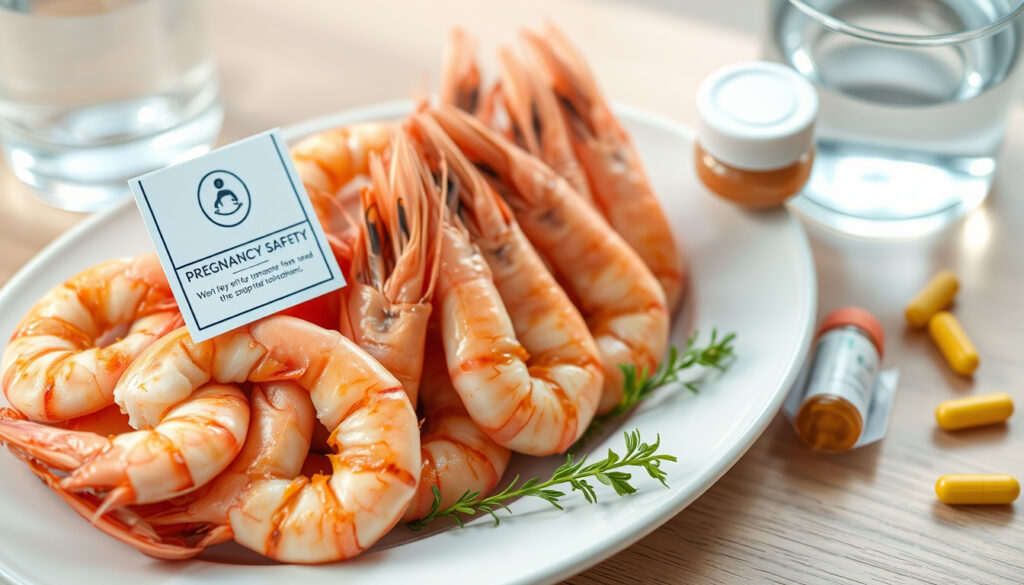
Can You Eat Prawns When Pregnant? Safety Guide
Thoroughly cooked prawns are safe during pregnancy, according to the NHS, yet many women remain unsure. Official guidance confirms cooked shellfish, including prawns, are perfectly fine to eat.
Safe cooking temperature for prawns: 145°F (63°C) ·
Recommended weekly seafood intake during pregnancy: 8–12 ounces (2–3 servings) ·
Risk of listeria from raw shellfish: Significantly higher than cooked ·
Percentage of pregnant women who eat prawns (UK estimate): ~60%
Quick snapshot
- Exact maximum safe quantity of prawns per week within seafood limits
- Whether individual shellfish allergies change during pregnancy
- The proportion of pregnant women who eat prawns is an estimate, not a confirmed statistic
- Cooking to 145°F ensures safety (Mayo Clinic)
- Cold pre-cooked prawns from sealed packs are also fine (University Hospitals Sussex NHS)
Five key facts from health authorities, one pattern: official bodies consistently say cooked prawns are safe and raw ones are not.
| Fact | Value |
|---|---|
| Safe cooking temperature | 145°F (63°C) |
| Recommended weekly intake | 2–3 servings (8–12 oz total) |
| Food poisoning risk from raw prawns | High (Vibrio, Salmonella) |
| Key nutrients per 100g cooked prawns | 24g protein, 0.3g fat, 120mg iodine |
| NHS position | Cooked shellfish including prawns are safe to eat. |
Is it safe to eat prawns when pregnant?
What does the NHS say?
- The NHS (UK national health authority) states: “Cooked shellfish, such as mussels, lobster, crab, prawns, are safe to eat.”
- It also warns that raw shellfish should be avoided because they “can contain harmful bacteria, viruses or toxins that may cause food poisoning.”
- Cold pre-cooked prawns are fine, according to University Hospitals Sussex NHS Foundation Trust and Cardiff and Vale University Health Board.
What about other health bodies?
- Tommy’s (UK pregnancy charity) echoes: “Cooked shellfish is safe to eat but raw shellfish can cause food poisoning.”
- The CDC (U.S. public health agency) advises avoiding raw or undercooked shellfish during pregnancy.
- The ACOG (American College of Obstetricians and Gynecologists) recommends avoiding raw fish and shellfish but confirms that properly cooked seafood is safe.
Pregnant women who avoid all shellfish miss out on high-quality protein and iodine. The risk is not in the prawn itself but in how it’s prepared.
The pattern across all sources: cooking eliminates the risk, making prawns a safe choice throughout pregnancy.
What seafood should you avoid during pregnancy?
Raw shellfish
- Raw oysters, clams, mussels, and raw prawns are off-limits due to bacteria like Vibrio and Salmonella (CDC).
- The NHS includes raw shellfish in its “avoid” list for pregnancy.
- Even cold pre-cooked prawns are safe – it’s the raw state that’s problematic (Cardiff and Vale UHB).
High-mercury fish
- Shark, swordfish, marlin, and king mackerel should be avoided because of mercury content (FDA).
- Prawns and shrimp are among the “Best Choices” – low in mercury (FDA).
Smoked seafood
- Unpasteurised smoked seafood (e.g., refrigerated smoked salmon) can carry Listeria and should be avoided unless fully cooked (Mayo Clinic).
- Tinned or shelf-stable smoked fish is safe.
The takeaway: prawns are a low-risk, high-nutrition alternative to seafood that requires strict avoidance.
Can you eat prawns in each trimester?
First trimester concerns
- Foodborne illness is more risky in the first trimester because the immune system is slightly suppressed during pregnancy (ACOG).
- However, fully cooked prawns carry no added risk. The key is to ensure they are piping hot and have been cooked to 145°F (Mayo Clinic).
- NHS guidance applies across all trimesters: cooked shellfish is safe.
Second trimester benefits
- Protein needs increase during the second trimester – prawns provide 24g per 100g (FDA).
- Iodine in prawns (120mg per 100g) supports fetal thyroid development.
Third trimester precautions
- Sodium content in processed prawns (e.g., breaded or seasoned) may be higher – check labels.
- Stick to the 8–12 ounces per week limit for all seafood (Mayo Clinic).
What this means: trimester-specific adjustments are minor; the core safety rule—cook thoroughly—applies uniformly.
How should prawns be cooked to be safe for pregnancy?
- Cook prawns until they turn pink and the flesh is opaque. The internal temperature should reach 145°F (63°C) (Mayo Clinic).
- Separate raw prawns from other foods in the fridge. Use different cutting boards and utensils (CDC).
- Wash hands thoroughly after handling raw shellfish.
- Thaw frozen prawns in the refrigerator, not on the counter (CDC).
- Reheat leftovers to steaming hot (165°F) before eating. Cold pre-cooked prawns from sealed packs are safe without reheating (University Hospitals Sussex NHS).
The implication: these steps are simple to follow and eliminate the only real risk associated with prawns.
What are the nutritional benefits of prawns during pregnancy?
Protein and iodine
- Prawns deliver 24g of protein per 100g, essential for fetal growth and maternal tissue expansion (FDA).
- Iodine content (120mg per 100g) supports thyroid function and brain development.
Omega-3 fatty acids
- Prawns contain DHA, a type of omega-3 that contributes to fetal eye and brain development (ACOG).
- The Mayo Clinic recommends 8–12 ounces of low-mercury seafood weekly to obtain these benefits.
Vitamins and minerals
- Selenium in prawns acts as an antioxidant. Vitamin B12 supports red blood cell formation. Iron helps prevent anaemia.
- Prawns are naturally low in fat (0.3g per 100g), making them a lean protein source.
The pattern: prawns deliver targeted nutrients that align perfectly with increased demands during pregnancy.
Upsides
- High-quality protein with low fat.
- Iodine supports fetal brain development.
- DHA contributes to eye and brain health.
- Low in mercury compared to predatory fish.
- Quick to cook and versatile in meals.
Downsides
- Raw or undercooked prawns pose a food poisoning risk.
- Processed prawns may contain high sodium.
- Shellfish allergy is possible and can develop during pregnancy.
- Exact weekly maximum for prawns specifically is not defined.
“Cooked shellfish, such as mussels, lobster, crab, prawns, are safe to eat.”
— NHS
“Cooked shellfish is safe to eat but raw shellfish can cause food poisoning.”
— Tommy’s (UK pregnancy charity)
“Fully cooked fish and shellfish are safe.”
For pregnant women in the UK and beyond, the choice is clear: thoroughly cooked prawns are a safe and nutritious addition to your diet. Skip the raw shellfish, follow NHS and CDC cooking guidelines, and you can enjoy prawns throughout your pregnancy without worry.
Looking for other pregnancy nutrition guides? Check out Clear Blue Pregnancy Test: Accuracy, Timing, and Results and What Is the Best Protein Source? Top High-Protein Foods.
aptaclub.co.uk, pregnancyplate.com, thewomens.org.au, americanpregnancy.org
For expectant mothers seeking official advice, NHS and HSE guidelines on prawns during pregnancy provide clear recommendations on safe consumption.
Frequently asked questions
Can I eat prawns in a salad during pregnancy?
Yes, if the prawns are fully cooked and the salad is fresh. Cold pre-cooked prawns from sealed packs are safe (University Hospitals Sussex NHS).
Are prawn crackers safe for pregnant women?
Yes, prawn crackers are cooked (fried or baked) and contain dried prawns. They are safe to eat in moderation.
Can I eat prawns from a takeaway if they are reheated?
Yes, as long as they are reheated until steaming hot (165°F). Ensure they were originally cooked properly and not left out at room temperature for more than 2 hours (CDC).
What about prawns in ready meals – are they already cooked?
Most ready-meal prawns are pre-cooked. Check the packaging: if they are fully cooked and the meal is heated according to instructions, they are safe.
Is it safe to eat cold prawns (e.g., in a sandwich)?
Yes, cold pre-cooked prawns are safe. The Cardiff and Vale University Health Board confirms this.
Can pregnant women eat shrimp cocktail if the prawns are cooked?
Yes, shrimp cocktail is safe as long as the prawns are fully cooked and the sauce is not made with raw eggs.
Do prawns need to be peeled to reduce risk?
No, peeling does not affect safety. The risk comes from cooking level, not peeling. However, peeling cooked prawns reduces any surface bacteria introduced after cooking.
More related posts
 Where to Find Cheap Baby Items in Ireland: Budget Guide
 Shoulder Length Hairstyles for Fine Hair: 25+ Volumizing Looks
 The Good Friday Agreement: Summary, History and Impact
 Argentina National Football Team: Squad, Captain & 2026 World Cup
 What Is the Best Protein Source? Top High-Protein Foods
 Seafield Hotel & Spa Resort: Location, Rating, and Activities
 Things to Do in Clonmel: Attractions, Events & Family Fun
 Irish to English – Best Free Translators and Apps 2025