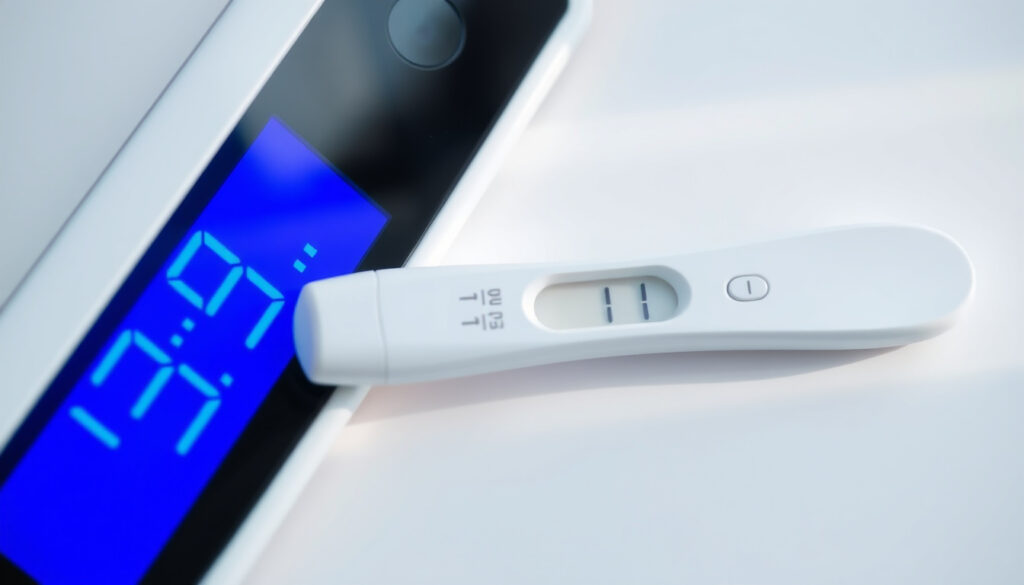
Clear Blue Pregnancy Test: Accuracy, Timing, and Results
Anyone who has stared at a pregnancy test waiting for that line or word knows the mix of hope and anxiety, and Clearblue—the brand that fills pharmacy shelves across the country—promises over 99% accuracy from the day of your missed period. This guide unpacks what those results really mean, how early you can test, and the mistakes that could lead to a confusing outcome.
Accuracy from day of missed period: Over 99% ·
Earliest detection before missed period: 6 days ·
Clearblue Digital Weeks Indicator range: 1‑2, 2‑3, 3+ weeks ·
Result display type: Digital or line (depending on model)
Quick snapshot
- Over 99% accurate from the day of your missed period (Clearblue (manufacturer of home pregnancy tests))
- Detects hCG as early as 6 days before missed period (Clearblue (manufacturer of home pregnancy tests))
- Digital models show “Pregnant” or “Not Pregnant” plus weeks (Clearblue manufacturer site) (Clearblue (manufacturer of home pregnancy tests))
- Exact false‑positive rate per user – rare but possible (see clarity section)
- Effect of very dilute urine on detection sensitivity for all models (see clarity section)
- Test window: from 6 days before missed period onward (Clearblue manufacturer site)
- Best accuracy from day of missed period (Clearblue manufacturer site)
- Positive result: consult a doctor or midwife for confirmation and care planning
- Negative but no period: retest in a few days or wait until missed period for most accurate result
Six core specifications, one pattern: Clearblue’s entire range is built around the same underlying immunometric assay, but sensitivity and result display vary by model.
| Specification | Value |
|---|---|
| Accuracy (from day of missed period) | >99% |
| Earliest detection | 6 days before missed period (Ultra Early model) |
| Result type | Digital (text) or line (plus/minus) |
| Time to result | 3 minutes (Rapid), 3‑5 minutes (others) |
| Test sensitivity | 10 mIU/mL (early detection models) |
| Storage | Room temperature, away from moisture |
How early can a Clearblue detect pregnancy?
Clearblue offers two tiers of early detection. The Ultra Early model can detect hCG up to 6 days before your missed period — that’s 5 days before the expected period, according to the manufacturer (Clearblue manufacturer site). The Rapid Detection model can be used 5 days before the missed period (Clearblue manufacturer site).
Is 3 weeks pregnant too early to test?
- Three weeks gestational age (counting from last period) typically means only about one week since conception — hCG may still be very low.
- Clearblue’s early detection test has a sensitivity of 10 mIU/mL (Clearblue manufacturer site), but even at that level, testing before implantation may give a false negative.
- Waiting until the day of the missed period pushes accuracy to over 99% (Clearblue manufacturer site).
Can you take a pregnancy test at night?
- Clearblue advises that if you are testing before your expected period, first‑morning urine is best because the pregnancy hormone tends to be more concentrated (Clearblue manufacturer site).
- After a missed period, any time of day works because hCG levels are usually high enough (Clearblue manufacturer site).
- If you must test early at night, hold your urine for at least four hours before testing to increase concentration.
The implication: most false negatives happen because users test too early or at the wrong time of day. Timing isn’t just a detail — it’s the biggest controllable variable.
How far am I if Clearblue says 1/2 weeks?
Clearblue Digital with Weeks Indicator measures the time since conception, not gestational age (which counts from your last menstrual period). A result of 1‑2 weeks means conception occurred about 1‑2 weeks ago — that corresponds to 3‑4 weeks gestational age (Clearblue manufacturer site). The test is calibrated against ultrasound dating and is 93% accurate in detecting the weeks range.
Is 1/2 weeks pregnant actually 4 weeks?
- Yes — “1‑2 weeks since conception” is roughly equivalent to 3‑4 weeks of gestational age (pregnancy counting from LMP).
- This confusion causes many users to think they are “less pregnant” than they are. The digital indicator shows time since conception, which is always about two weeks shorter than gestational weeks.
Is 4 weeks pregnant actually 2 weeks?
- No — 4 weeks gestational age typically means conception happened about 2 weeks ago. Clearblue would read “1‑2 weeks” in that scenario.
- The Weeks Indicator is designed to help estimate when conception occurred, not to measure gestational age.
What this means: the weeks indicator is a helpful orientation, but it’s easy to misinterpret. Users who expect gestational weeks may feel misled.
How do I tell if my Clearblue pregnancy test is positive?
Reading the result correctly depends on the model. Digital tests display “Pregnant” or “Not Pregnant” plus weeks if applicable. Line tests show a clear plus sign (+) for positive and a minus sign (−) for negative (Clearblue manufacturer site).
Clear blue pregnancy tests results interpretation
- For line tests, the control window must show a red line for validity (Clearblue manufacturer site).
- Any line — even a faint one — in the test window within the read time (typically 5 minutes for early detection, 3 minutes for rapid) means pregnant. Line darkness does not matter (Clearblue manufacturer site).
- Do not read results after 10 minutes (for early detection) because evaporation lines can appear and cause confusion (Clearblue manufacturer site).
What do the symbols mean?
- Digital: “Pregnant” or “Not Pregnant” — no ambiguity.
- Line: plus (+) = pregnant; minus (−) = not pregnant; no line in control = invalid.
- Rapid Detection can show a positive result as fast as 1 minute (Clearblue manufacturer site).
A faint line is still a positive. Many users mistakenly discard early positives because they expect a dark line, leading to unnecessary anxiety or delaying prenatal care.
The trade‑off: line tests are cheaper but require careful timing and interpretation. Digital removes guesswork but costs more.
Can Clearblue give a false positive?
False positives are rare with Clearblue tests because they are designed to detect hCG specifically. However, they can occur under certain circumstances (Clearblue manufacturer site).
What causes a false positive on a pregnancy test?
- Chemical pregnancy (early miscarriage shortly after implantation)
- Recent miscarriage or abortion (hCG may still be present)
- Certain medications containing hCG (fertility drugs)
- Medical conditions such as ovarian cysts or rare hCG‑producing tumors
Can medications or medical conditions affect the result?
- Fertility treatments that include hCG injections can produce false positives.
- Other medications (painkillers, antibiotics, birth control) do not interfere with Clearblue tests.
- If you get an unexpected positive, wait 48 hours and retest with a new test. If still positive, consult a healthcare provider (Clearblue manufacturer site).
A false positive is psychologically jarring, but the true‑positive rate for Clearblue is over 99% when used correctly. The bigger risk is a false negative from early testing.
The pattern: unexpected positives should be taken seriously but verified with a repeat test and medical confirmation.
Can you mess up a pregnancy test?
User error is the most common cause of inaccurate results. Clearblue’s Floodguard Technology aims to reduce the #1 reported cause of user error by over 70% (Clearblue manufacturer site), but mistakes still happen.
Is 4am considered first morning urine?
- Yes — if you have not urinated for several hours before 4am, that sample is concentrated enough and can be used as first morning urine.
- Clearblue recommends using first morning urine when testing before the missed period (Clearblue manufacturer site).
What are common mistakes when using a Clearblue test?
- Testing too early (before sufficient hCG has built up)
- Not using enough urine — the absorbent tip must be in the stream for a full 5 seconds (or dipped for 5‑20 seconds depending on model) (Clearblue manufacturer site)
- Misreading the time window — reading too early or too late
- Using an expired test
- Reading the result after the suggested time (e.g., after 10 minutes for early detection) (Clearblue manufacturer site)
The consequence: a single error can turn a clear positive into a confusing negative, or vice versa. Clearblue’s Floodguard helps, but attention to detail is the real safeguard.
How to Use a Clearblue Pregnancy Test: Step-by-Step
Regardless of which Clearblue model you buy, the basic steps are similar. Always read the leaflet that comes with your test because timing and dip duration vary. Based on Clearblue’s official how‑to guide (Clearblue (manufacturer of home pregnancy tests)), here is the general procedure.
- Check the expiry date – do not use an expired test.
- Remove the test stick from its foil wrapper and take off the cap.
- Place the absorbent tip in your urine stream for 5 seconds, or dip it in a collected sample for the time specified (5–20 seconds depending on model).
- Replace the cap and lay the test flat.
- Wait the recommended time – most tests give a result in 3 minutes (Rapid Detection can show “Pregnant” in as little as 1 minute) (Clearblue manufacturer site). Do not read after 10 minutes.
- Read the result – digital: look at the words; line tests: check the control line first, then the test window.
If you are testing early, use first morning urine. After the missed period, any time of day works (Clearblue manufacturer site).
Confirmed Facts vs. What’s Unclear
Confirmed facts
- Clearblue tests are over 99% accurate from the day of your missed period when used correctly (Clearblue (manufacturer of home pregnancy tests)).
- A positive result reliably indicates presence of hCG, which occurs after implantation (Clearblue manufacturer site).
What’s unclear
- Exact reason for a false positive in any individual case may require medical evaluation (rare, but possible with certain medications or conditions) (Clearblue manufacturer site).
- The effect of very dilute urine on detection sensitivity is not precisely quantified for all models independently.
- Individual hCG rise rates vary; “6 days before missed period” is a statistical average, not a guarantee for every person.
- Digital weeks indicator calibration against ultrasound dating may vary by user population and timing of test.
- Early detection model sensitivity of 10 mIU/mL is a manufacturer specification; real-world performance may differ based on urine concentration and individual hCG production rates.
What the Experts Say
“Clearblue Rapid Detection Pregnancy Test is over 99% accurate from the day of your expected period. It can be used as early as 5 days before the missed period.”
— Clearblue (manufacturer of home pregnancy tests)
“If you think you might be pregnant, waiting until the day you expect your period will give the most accurate result. Testing earlier increases the chance of a false negative.”
— Better Health Channel (Victoria State Government health service)
Both sources underscore the same message: accuracy depends on timing. Clearblue’s product claims are backed by manufacturer testing, while the government health service provides independent context that reinforces the importance of waiting.
Summary
Clearblue pregnancy tests are reliable tools when used correctly, but their accuracy hinges on timing, technique, and understanding what the result actually means. For the person staring at that stick, the choice is clear: test from the day of your missed period for the most definitive answer, use first‑morning urine if you test early, and if the result feels off, repeat after 48 hours. For anyone who gets a positive, the next step is a call to a healthcare provider — because a home test is only the beginning.
au.clearblue.com, youtube.com, clearblue.com, clearblue.com, youtube.com, clearblue.com
Frequently Asked Questions
What is the difference between Clearblue Digital and Clearblue Rapid Detection?
The Rapid Detection shows a line result (plus/minus) and can give a positive result in as fast as 1 minute. The Digital model shows “Pregnant” or “Not Pregnant” in text and, for the Weeks Indicator version, also displays how many weeks since conception. Both are over 99% accurate from the day of missed period (Clearblue manufacturer site).
Can I reuse a Clearblue pregnancy test?
No. Clearblue tests are single-use only. The test stick cannot be reused, and the result window will not give reliable information a second time.
How long do I need to wait for the result after peeing on the stick?
For most Clearblue models, wait 3 minutes. The Rapid Detection can show “Pregnant” as early as 1 minute. For the Early Detection line test, wait 5 minutes and do not read after 10 minutes (Clearblue manufacturer site).
Does Clearblue work after my missed period?
Yes — that is when the test is most accurate, over 99% reliable. You can test any time of day after your missed period (Clearblue manufacturer site).
Is Clearblue accurate for ectopic pregnancy detection?
A Clearblue test will detect hCG in the case of an ectopic pregnancy, but it cannot differentiate between an ectopic and a uterine pregnancy. If you experience severe pain or bleeding, seek medical attention regardless of the test result.
Can I use a Clearblue test if I am on birth control?
Yes — birth control pills, patches, rings, and IUDs do not affect hCG levels, so they will not interfere with the test result. However, hormonal contraceptives can sometimes cause irregular bleeding that may be mistaken for a period.
What should I do if my Clearblue test shows “Not Pregnant” but I think I am pregnant?
If you still have pregnancy symptoms and have not started your period, wait a few days and test again with first‑morning urine. It is possible that you tested too early or that your urine was too dilute. If the negative result persists and your period does not come, consult your healthcare provider (Better Health Channel, Victoria State Government health service).
More related posts
 Peter McVerry Trust Secret Fees: Controversy & Deals
 Houses for Sale in Carlow: A Complete Buying Guide
 What Is a Scrambler Bike? Irish Law & History
 Irish to English – Best Free Translators and Apps 2025
 New Balance Fresh Foam 1080 – Plush v13 for Daily Miles
 DoneDeal Classic Cars Ireland: Find & Buy Vintage Cars
 Manchester United Transfer News: Latest Rumours & Updates
 Celtic vs Falkirk Lineups: Confirmed Starting XI and Recap