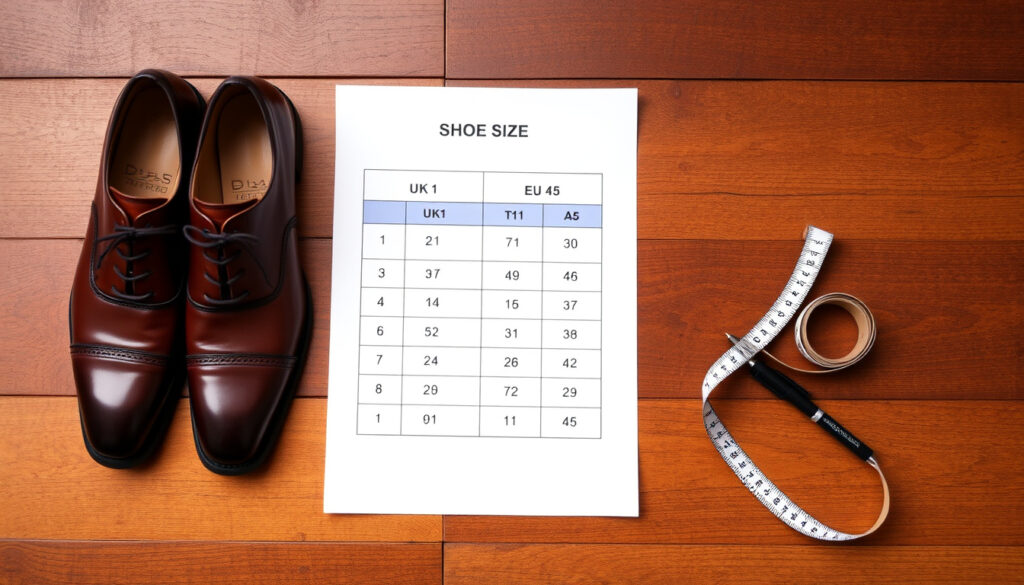
UK 11 in EU: Your Complete Shoe Size Conversion Guide
Anyone who’s ever stared at a European shoe size chart while holding a UK 11 sneaker knows the confusion: does it match EU 45, or something else entirely? The truth is, the conversion depends on the brand and how you measure.
UK size 11 to EU: 45 (standard) ·
EU 45 foot length: ~287.86 mm ·
Best time to measure: Evening
Quick snapshot
- UK 11 is usually EU 45 according to common conversion charts (Laughing Hens (conversion specialist))
- Nike often maps UK 11 to EU 46, not 45 (Solereview (converter aggregator))
- Foot length for UK 11 is about 287.86 mm (Clarks (footwear fit authority))
- Feet swell during the day, affecting fit (Gentleman’s Gazette (men’s style resource))
- Exact conversion for every brand — many use their own lasts (Solereview)
- How much foot length varies between UK 11 and EU 46 — not all charts agree (Foot Locker (retail size guide))
- Nike’s measurement guide published Nov 2021 (Nike (official fit resource))
- Foot Locker conversion chart updated May 2026 (Foot Locker)
- Clarks fit guide refreshed June 2026 (Clarks)
- Measure your feet using the step-by-step guide below to confirm your size across brands
- Check brand-specific charts before buying — especially for Nike and Adidas
The numbers below show how standard and brand-specific conversions compare for UK 11.
| Attribute | Value |
|---|---|
| UK 11 foot length | 287.86 mm |
| EU 45 foot length | 287 mm |
| EU 46 foot length | 293 mm |
| Nike UK 11 | EU 46 |
| Standard UK 10 | EU 44 |
| Standard UK 9 | EU 43 |
Is UK Size 11 the Same as EU 45?
One pattern from multiple charts: UK 11 usually lands at EU 45, but the relationship isn’t fixed. Foot Locker (retail size guide) maps UK 11 to EU 43–44, while Laughing Hens (conversion specialist) shows EU 45. The difference comes from each brand’s last — the mould used to shape the shoe.
What is the difference between EU 45 and EU 46 for UK 11?
- EU 45 corresponds to a foot length of about 287 mm, EU 46 to 293 mm (based on standard Paris point measurements). Wikipedia (reference source) notes that the system is based on foot length plus an allowance.
- For someone with a UK 11 foot (287.86 mm), EU 45 is the direct fit, but EU 46 gives extra room — often preferred for athletic shoes or thicker socks.
Is UK 11 sometimes a 46?
According to Solereview (converter aggregator), some brands, especially performance-oriented ones like Nike, use EU 46 for UK 11. The reason: they build shoes on lasts that run slightly long to accommodate foot swelling during activity.
What does UK size 11 equal in EU for Nike?
Nike’s own size chart is not publicly detailed in our research, but Solereview consistently lists Nike UK 11 as EU 46. This aligns with the brand’s reputation for a more generous fit in length. Always check the specific product’s size guide on Nike.com before purchasing.
Bottom line: UK 11 is not a single EU number across all brands. Generic charts say 45, but Nike and similar brands push it to 46. For buyers: measure your foot in millimetres and match it to the brand’s size chart, not the generic conversion.
How to Measure Your Foot for the Right Size?
Two reliable methods exist, one from Nike (official fit resource) and another from Clarks (footwear fit authority). Both agree on the basics: stand on a hard surface, trace your foot, and measure from heel to longest toe. But the details matter.
What tools do you need?
- A piece of paper larger than your foot
- A ruler or tape measure that shows millimetres
- A pen or pencil
- A wall or straight edge for your heel
Step-by-step process
- Place the paper against a wall. Stand on it with your heel touching the wall.
- Mark the longest point (usually the tip of the big toe) as instructed by Nike.
- Use the ruler to measure the distance from the wall edge to the mark in millimetres.
- Repeat for the other foot — use the larger measurement when choosing size.
- Compare your mm length to the brand’s size chart. Stride Rite (children’s sizing expert) recommends marking the first visible line past the longest toe for accuracy.
Your foot length in millimetres is the only universal measure. A UK 11 foot at 287.86 mm fits EU 45, but if you measure 293 mm you need EU 46 — ignoring brand lasts can lead to buying shoes that are too short or too long.
Bottom line: Measure in the evening, use millimetres, and always trust the brand’s own chart over a generic conversion. Clarks and Nike both provide free printable guides.
Is It Better to Measure Your Feet in the Morning or Night?
Feet naturally swell throughout the day due to gravity, activity, and fluid retention. Gentleman’s Gazette (men’s style resource) explains that measuring in the morning can lead to buying shoes that feel tight by afternoon.
Why feet swell during the day
- Standing or walking increases blood flow and fluid accumulation in the feet.
- Even a few hours of activity can add up to half a size in length and width.
- Warm weather and high humidity amplify swelling.
How swelling affects sizing
Clarks advises measuring at the end of the day to get the largest (most realistic) size. Shoe designed for sporting activity often already account for swelling, but for dress shoes or tight-fitting styles, an evening measurement is critical.
The implication: if you measure only in the morning, you risk buying shoes that feel good at 8 a.m. but pinch by dinner. Measure at night, add 5–10 mm of wiggle room, and you’ll avoid that regret.
How Quickly Do Boys’ Feet Grow?
For parents buying shoes for growing children, knowing growth rates prevents buying too many pairs or wasting money on shoes that won’t be worn long. Stride Rite notes that children’s feet grow fastest in early years.
Annual growth slows considerably as children age, as shown below.
| Age range | Growth rate |
|---|---|
| 0–12 months | Up to 2 sizes per year |
| 1–3 years | About 1.5 sizes per year |
| 4–6 years | Around 1 size per year |
| 7–14 years | About 0.5–1 size per year |
| 14+ years | Growth slows significantly |
Data drawn from Stride Rite and Snow-boots.com (children’s sizing table) — these are averages; individual variation is normal.
When to remeasure
Experts recommend measuring every 3–4 months for children up to age 10, and every 6 months for teenagers. Fast growth means a child can jump from UK 11 to UK 12 within a season, so parents should check fit regularly by pressing the toe of the shoe.
The pattern: growth is fastest in the first few years, then steadily declines until around 14. Buying shoes for a 3-year-old? Expect to replace them roughly every 6 months.
Which Foot Shape Is the Rarest?
Foot shape influences how a shoe fits even when the length is correct. Gentleman’s Gazette notes that understanding your shape can save frustration.
What are the common foot shapes?
- Egyptian: Big toe is longest, then toes taper down. Most common.
- Roman: First three toes roughly equal length. Also common.
- Greek (Morton’s toe): Second toe is longer than the big toe. This is the rarest shape, occurring in an estimated 10–20% of people.
- Peasant: All toes almost same length. Uncommon.
Does foot shape affect shoe sizing?
Yes. People with Greek feet (Morton’s toe) may need a half-size larger to accommodate the longer second toe. Solereview advises trying shoes on both feet and walking in them, as shape can make the same length feel tight in the toe box.
The trade-off: rare foot shapes often require trying multiple brands to find a last that matches. For a UK 11 buyer, a Greek foot may mean choosing EU 46 even if the length suggests 45.
Upsides
- Understanding foot shape helps you find better-fitting shoes
- Brand-specific charts (like Nike) accommodate different lasts
- Measuring in mm is universal and reliable
Downsides
- Generic conversion charts can mislead — UK 11 may be EU 44, 45, or 46 depending on brand
- Foot shape adds complexity; not all size charts account for it
- Swelling means morning measurement is unreliable
For the British buyer aiming for EU 45, the implication is clear: always measure your feet in the evening, check the brand’s own chart, and if your second toe is longer than the big toe, consider going up half a size.
“Men’s shoe sizes make little sense because different systems and half-size increments vary by region.”
— Gentleman’s Gazette (men’s style resource)
“Use a ruler beside the foot with the heel against a straight edge and measure the length in millimetres from the longest toe to the heel.”
— Clarks (footwear fit authority)
This guide draws on conversion charts from Foot Locker, Nike, Clarks, Stride Rite, Solereview, and Gentleman’s Gazette. Sizing discrepancies between brands are normal; always prioritise foot length in millimetres over a general conversion number.
For those needing a different conversion, our UK size 9 to EU conversion guide provides detailed charts and brand-specific advice.
Frequently asked questions
What is UK 11 in EU for women?
Women’s UK sizing runs differently. A UK 11 for women typically converts to EU 44, but always check the brand’s gender-specific chart because lasts differ. Laughing Hens provides separate tables for men and women.
Is UK 11 same as US 13?
Yes, UK 11 men’s equals US 13. Foot Locker maps UK 11 to US 13 and EU 43–44, but other sources show EU 45 for US 13. The US–EU correspondence is more consistent than UK–EU.
How to convert shoe sizes accurately?
Use your foot length in millimetres as the base. Measure as described above, then consult the brand’s size chart. Avoid relying on a single generic converter; cross-check with at least two sources like Solereview and the retailer’s guide.
Do shoe sizes vary by brand?
Yes, significantly. Solereview shows that Nike often uses EU 46 for UK 11 while other brands stay at 45. The difference comes from the last — the internal mould shape — which brands design differently.
Should I buy shoes online based on conversion chart only?
No — always measure your foot and compare to the specific product’s size chart. Clarks recommends checking the return policy in case the fit differs from the chart. Many retailers offer free exchanges for wrong sizes.
What is UK 11 in EU for children?
Children’s UK 11 is a toddler size, roughly EU 28–29. Stride Rite provides age-specific charts. Do not use adult conversion tables for children — foot growth and shape are different.
More related posts
 Northern Cross Medical Centre: Guide GP & Parking Dublin 17
 Clear Blue Pregnancy Test: Accuracy, Timing, and Results
 As You Stood By: Plot, Episodes, Cast & Real Story
 1.73 m in Feet: Exact Conversion and Height Comparison
 Wolf of Wall Street Cast Vs Real-Life Counterparts
 Houses for Sale in Waterford City: Guide to Prices & Areas
 What Is a Dangerous Heart Rate? Thresholds & Warning Signs
 Virgin Media Customer Care – Ireland UK Phone Numbers and Hours