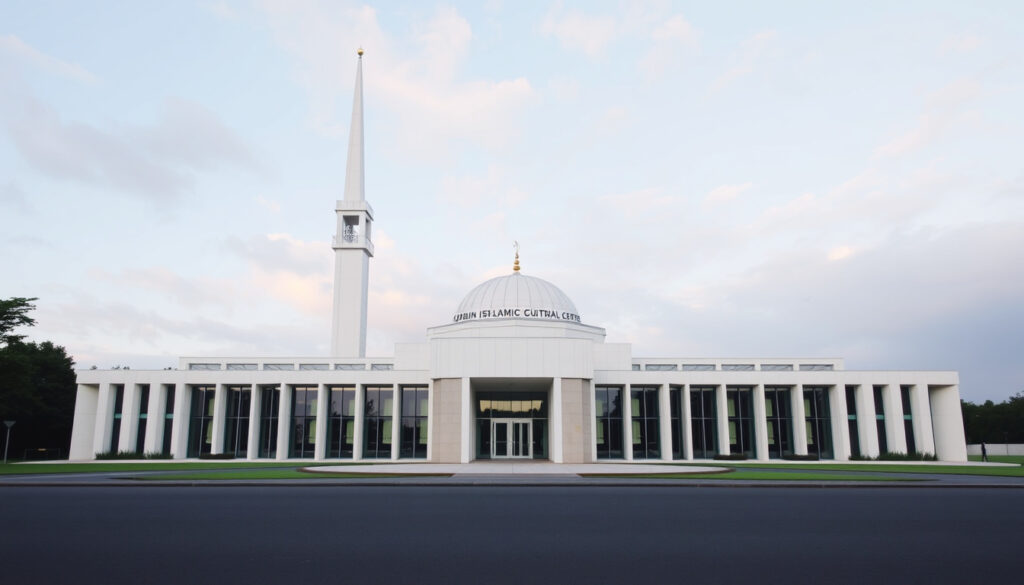
Dublin Islamic Cultural Centre: Ireland’s Largest Mosque
Few places in Dublin combine quiet reflection with community hustle quite like the Islamic Cultural Centre of Ireland in Clonskeagh, home to the country’s largest mosque, a primary school, and a library — and it has been a central part of Muslim life in Ireland since 1996. Here’s what you need to know about this busy institution, its facilities, and its role in bridging cultures.
Established: 1996 ·
Location: Clonskeagh, Dublin ·
Founder: Al-Maktoum Foundation ·
Mosque Capacity: 1,700–5,000 worshippers ·
Facilities: Mosque, library, school, gym, conference hall
Quick snapshot
- Opened in 1996, funded by the Al-Maktoum Foundation (The Irish Times (Ireland’s leading newspaper))
- Located at 19 Roebuck Road, Clonskeagh, Dublin 14 (Irish Muslim Council (official representative body))
- Includes a mosque, two prayer halls, a Muslim national school, sports hall, library, exhibition hall, shop, restaurant, and mortuary (The Irish Times) (The Irish Times (Ireland’s leading newspaper))
- Exact daily visitor numbers — the centre is described as the busiest Islamic centre in Ireland but precise footfall is not published (The Irish Times)
- Future expansion plans — no official statement on further development
- Reopened in February 2026 after a nine-month closure, just in time for Ramadan (RTÉ News (Ireland’s national public broadcaster))
- The centre continues to host daily prayers, educational programmes, and interfaith events — including Culture Night Dublin participation (The Irish Times)
Five key facts, one pattern: the centre is as much a community hub as a place of worship — offering education, fitness, and social services alongside religious practice.
| Attribute | Details |
|---|---|
| Location | Clonskeagh, Dublin (Irish Muslim Council) |
| Established | 1996 (The Irish Times) |
| Founder | Al-Maktoum Foundation (The Irish Times) |
| Mosque capacity | 1,700 (Irish Times) to 5,000 (RTÉ) — RTÉ News reports 5,000; The Irish Times says 1,700 |
| Weekly Friday attendance | Around 1,000 (RTÉ News) |
| Schools | Muslim national school (250 pupils) and Quranic school (850 children) (The Irish Times) |
| Staff | Approximately 20 (The Irish Times) |
| Additional facilities | Library, sports hall, exhibition hall, shop, restaurant, mortuary, women’s centre, eight apartments (The Irish Times) |
The implication: the centre’s capacity is a moving target — different sources cite different numbers, but all agree it’s the largest mosque in Ireland by a wide margin.
What is the Islamic Cultural Centre of Dublin?
History of the Islamic Cultural Centre of Ireland
The Islamic Cultural Centre of Ireland opened in 1996, funded by the Al-Maktoum Foundation of the UAE at a cost of IR£5 million (The Irish Times). The centre was built on a greenfield site in Clonskeagh, a suburb south of Dublin city centre, and quickly became the focal point for Ireland’s growing Muslim population. The Irish Times described it as “the major symbol of Islam in Ireland” (The Irish Times).
- Official opening: 1996
- Funding: Al-Maktoum Foundation (UAE)
- Construction cost: IR£5 million
Facilities and services
The centre is a self-contained complex. According to The Irish Times, it includes a main mosque, two smaller prayer halls, a Muslim national school, a sports hall, a library, an exhibition hall, an information centre, offices, a women’s education and social centre, a shop, a restaurant, eight apartments, and a mortuary. Journal Ireland (online news outlet) lists the core visitor-facing facilities as a mosque, multipurpose hall, bookshop, and restaurant.
- Daily prayers and Friday sermons
- Quran classes for 850 children
- Primary school for 250 pupils
- Interfaith events and open days
- Sports and leisure facilities
The centre functions more like a small campus than a traditional mosque — a model that mirrors the diverse needs of a community that numbers tens of thousands across Ireland.
Location and access
The centre is at 19 Roebuck Road, Clonskeagh, Dublin 14, as confirmed by the Irish Muslim Council. It is accessible by bus and car, and parking is available on site. The centre is open to visitors of all faiths, and non-Muslims are welcome to attend open days and interfaith events.
The pattern: the centre’s location in a leafy southern suburb, not a dense urban centre, reflects the post-1990s settlement pattern of Dublin’s Muslim community — many of whom moved to the suburbs for work and family life.
What is the largest mosque in Ireland?
The Clonskeagh Mosque
The mosque at the Islamic Cultural Centre of Ireland is widely cited as the largest in Ireland. The Irish Times reported that the mosque was “the largest in Ireland”. RTÉ News put the capacity at 5,000, while The Irish Times earlier stated 1,700. The discrepancy likely reflects the inclusion of external prayer spaces and overflow areas during peak times such as Eid.
- Largest mosque in Ireland (multiple sources)
- Capacity: 1,700–5,000 depending on source
- Weekly Friday attendance: ~1,000 (RTÉ News)
The “largest mosque” title is clear, but the exact capacity remains fuzzy — a reminder that attendance figures are fluid and often exceed official seating numbers during major religious events.
Size and capacity
The main prayer hall can accommodate more than 1,700 worshippers, according to The Irish Times. However, RTÉ News reported that the mosque can hold 5,000 people, citing the centre’s management. The variation likely comes from using different counting methods — indoor seating versus total site capacity including courtyards and overflow halls.
The implication: for practical purposes, the mosque is the largest in Ireland by any measure, and its size reflects the demographic reality that Dublin is home to the majority of Ireland’s Muslim population.
Architecture
The mosque’s architecture is modern Islamic, with a distinctive dome and minaret. The design incorporates traditional Islamic geometric patterns but uses contemporary materials. Wikipedia (online encyclopedia) notes that the complex was designed by architects from the UAE and built by Irish contractors. The building is a visible landmark on the Clonskeagh skyline.
- Modern Islamic style
- Dome and minaret
- Geometric patterns
- UAE architects, Irish builders
Why this matters: the architecture physically bridges two cultures — a design that is both distinctly Islamic and built to Irish standards, mirroring the centre’s broader mission of integration.
Which city in Ireland has the most Muslims?
Muslim population in Dublin
Dublin has the highest concentration of Muslims in Ireland. According to The Irish Times, the Clonskeagh centre is the busiest Islamic centre in the country, serving a metropolitan Muslim population that has grown rapidly since the 1990s. The 2022 census recorded over 83,000 Muslims in Ireland, with the majority in Dublin.
- Dublin: highest Muslim population density
- Over 83,000 Muslims in Ireland (2022 census)
- Majority reside in the Dublin region
Dublin’s Muslim population is not evenly spread — communities cluster around suburban areas like Clonskeagh, Blanchardstown, and Tallaght, often centred on a mosque or Islamic centre.
Other cities with Muslim communities
Outside Dublin, significant Muslim communities exist in Cork, Limerick, Galway, and Waterford. The Irish Muslim Council lists mosques and Islamic centres in all major Irish cities. Smaller communities are also present in towns like Dundalk, Athlone, and Portlaoise, reflecting the settlement patterns of immigrants from Africa, Asia, and Eastern Europe.
The trade-off: while Dublin offers the most comprehensive Islamic infrastructure, Muslims in other cities often have fewer facilities and must travel longer distances for community events.
Why are so many Muslims in Ireland?
Historical immigration patterns
Ireland’s Muslim population grew significantly from the 1990s onward, driven by immigration from Africa, Asia, and Eastern Europe. The Irish Times notes that the Clonskeagh centre was established in 1996 precisely to serve this expanding community. The Celtic Tiger economic boom (mid-1990s to 2008) attracted many workers from Muslim-majority countries, particularly in the IT, healthcare, and hospitality sectors.
- 1990s: first major wave of Muslim immigration
- Celtic Tiger: economic pull factor
- Sectors: IT, healthcare, hospitality
- Countries of origin: Nigeria, Somalia, Pakistan, Bosnia, Egypt, and others
Economic and educational opportunities
Ireland’s English-speaking environment, strong education system, and relatively open labour market made it an attractive destination. Many Muslims came to study at Irish universities and stayed to work. RTÉ News reported that the Clonskeagh mosque serves a diverse congregation that includes professionals, students, and families from over 40 nationalities.
The implication: the centre’s multi-ethnic congregation is a microcosm of Ireland’s broader migration story — a mix of global talent attracted by a small, open economy.
Asylum seekers and refugees
Ireland also received asylum seekers and refugees from conflict zones such as Somalia, Iraq, Syria, and Afghanistan. While the numbers are smaller than in other European countries, they have contributed to the Muslim community. The Irish Times notes that the centre provides support services for refugees, including language classes and legal advice.
Why this matters: the centre’s role extends beyond worship — it’s a settlement hub for new arrivals, helping them navigate Irish bureaucracy and society.
What do they do at an Islamic centre?
Daily prayers and religious activities
The centre holds five daily prayers, a Friday sermon (Jumu’ah), and special prayers for Eid and other Islamic holidays. According to RTÉ News, around 1,000 people attend the weekly Friday prayers. The mosque is open for individual prayer throughout the day, and the two smaller prayer halls provide additional space for women and latecomers.
- Five daily prayers
- Weekly Friday sermon
- Eid prayers (two per year)
- Tarawih prayers during Ramadan
- Quran recitation circles
For a community that often lacks a dedicated mosque within walking distance, the centre becomes the social and spiritual anchor of the week — not just for prayer, but for conversation, advice, and connection.
Educational programs
The centre runs a Muslim national school (primary level) with 250 pupils, and a Quranic school with 850 children, according to The Irish Times. It also offers adult education classes in Arabic, Islamic studies, and computer skills. The library holds a collection of books on Islam, Irish history, and multiculturalism.
- Primary school (Irish curriculum)
- Quranic school (evenings and weekends)
- Adult Arabic classes
- Islamic studies for converts
- Computer and language classes
The pattern: the centre invests heavily in education — the Quranic school alone has more than three times the pupils of the primary school, reflecting the community’s priority on religious literacy alongside secular education.
Community events and interfaith dialogue
The centre regularly hosts open days, interfaith iftars during Ramadan, and participation in Culture Night Dublin (The Irish Times). It also runs a women’s social centre, a sports hall for youth activities, and a restaurant that serves halal food to the public. The centre’s website promotes its role in “building bridges of understanding” (Islamic Cultural Centre of Ireland official website).
- Interfaith events and open days
- Culture Night participation (2024, 2025, 2026)
- Women’s education and social centre
- Youth sports programmes
- Public restaurant and shop
The implication: the centre is not a closed institution — it actively invites non-Muslims in, which is a deliberate strategy to counter prejudice and build understanding in a country where Islam is still a minority faith.
Timeline
- 1996 — Official opening of the Islamic Cultural Centre of Ireland (The Irish Times)
- 2000s — Expansion of facilities including school, gymnasium, and library (Wikipedia)
- January 2026 — Announcement that Ireland’s largest mosque would reopen in time for Ramadan after a nine-month hiatus (The Irish Times)
- 12 February 2026 — Official reopening of Clonskeagh Mosque (RTÉ News)
- 2024–2026 — Participation in Culture Night Dublin (The Irish Times)
The pattern: the reopening in early 2026 after a closure shows that even the largest mosque can face operational challenges, but the community’s ability to reorganise and reopen quickly reveals institutional resilience.
Clarity section
Confirmed facts
- The centre is funded by the Al-Maktoum Foundation (The Irish Times)
- It is located in Clonskeagh, Dublin 14 (Irish Muslim Council)
- The mosque is the largest in Ireland (The Irish Times)
- It reopened in February 2026 after a nine-month closure (RTÉ News)
- Includes a mosque, school, library, sports hall, and mortuary (The Irish Times)
What’s unclear
- Exact daily attendance figures — the centre is described as “the busiest Islamic centre in Ireland” but no precise count is published (The Irish Times)
- Future expansion plans — no official statement on further development
- Precise mosque capacity — sources vary between 1,700 and 5,000 (The Irish Times vs RTÉ News)
Quotes
“The centre in Clonskeagh is the major symbol of Islam in Ireland.”
— The Irish Times, 2018 (The Irish Times)
The centre’s mission is to “serve the Muslim community in Ireland and promote understanding of Islam through education, interfaith dialogue, and community services.”
— Islamic Cultural Centre of Ireland official website (ICCI official site)
Summary
The Islamic Cultural Centre of Ireland is more than a mosque — it’s a multi-purpose institution that has grown alongside Ireland’s Muslim community. With the largest mosque in the country, a school, a library, and a range of social services, it serves as both a religious anchor and a bridge to the wider Irish society. For Dublin’s Muslim community, the centre is not just a place to pray — it’s the place where identity, education, and belonging converge. For the rest of Ireland, the centre offers a rare window into a faith that is still often misunderstood. The choice is clear: either continue to build bridges through open doors and interfaith events, or risk losing the trust that those bridges have built over three decades.
Related reading: Our Lady of Clonfert · Sacred Space Daily Prayer
irishtimes.com, 5pillarsuk.com, fiveprayer.app, masjidbox.com, yelp.com, facebook.com
The Dublin Islamic Cultural Centre’s nine-month closure and subsequent reopening are detailed in a Clonskeagh Mosque guide.
Frequently asked questions
How do I get to the Islamic Cultural Centre of Ireland?
The centre is at 19 Roebuck Road, Clonskeagh, Dublin 14. It is accessible by Dublin Bus routes 11, 44, and 61, and by car via the N11. Parking is available on site.
Is there parking available at the centre?
Yes, there is a car park on the grounds. It can get busy during Friday prayers and major events, so arriving early is recommended.
Are non-Muslims welcome to visit?
Yes, the centre welcomes visitors of all faiths. Open days are held regularly, and the centre participates in Culture Night Dublin. Non-Muslims are asked to dress modestly and remove shoes before entering the prayer hall.
What are the prayer times at the centre?
Prayer times follow the standard Islamic schedule based on the sun’s position. The centre publishes daily times on its website (islamireland.ie) and on notice boards at the entrance.
Does the centre offer funeral services?
Yes, the centre has a mortuary and provides Islamic funeral services, including washing, shrouding, and funeral prayers. Contact the centre directly for arrangements.
How can I donate to the centre?
Donations can be made via the centre’s website or in person at the office. The centre is a registered charity and accepts zakat and sadaqah.
What languages are used in services?
The Friday sermon is delivered in English and Arabic. Quran classes are taught in Arabic with English explanations. The primary school follows the Irish curriculum through English, with Arabic taught as a subject.
More related posts
 Knight & Day Jewellery: Irish Brand Guide
 Lacey Home and Away: Real Name, Age, and Relationship with Theo
 List of Shops in Dundrum Shopping Centre – Full Directory
 Meghan, Duchess of Sussex: Verified Facts and Key Stories
 What Is a Deductible in Insurance? How It Works Explained
 Northern Cross Medical Centre: Guide GP & Parking Dublin 17
 Paul Thomas Anderson Movies – Filmography, Rankings, Watch Guide
 De Longhi Coffee Machine: Use, Clean & Ireland Guide