Why Is Temple Bar Famous? History, Pubs & Tourist Trap Truth
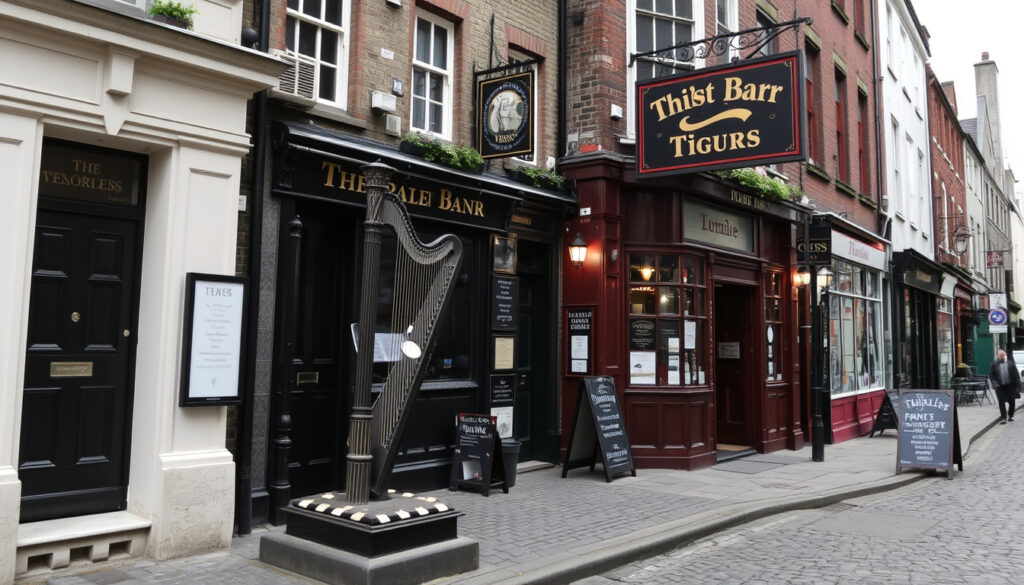
You’ve seen the photos: cobblestone streets, a bright red pub facade, crowds spilling onto the pavement with pints in hand. Temple Bar is the face of Dublin for millions of visitors each year — but the story behind that fame is more tangled than a single snapshot suggests. This article breaks down how a derelict 18th-century quarter became a global nightlife magnet, why it’s also called the world’s third biggest tourist trap, and what that means for anyone planning a visit.
Whiskey varieties at The Temple Bar pub: 450+ ·
Global tourist trap ranking: 3rd (2019 survey) ·
Year The Temple Bar pub was established: 1840 ·
Number of pubs in Temple Bar area: over 20 ·
Average pint price in Temple Bar: €7–8
Quick snapshot
- Named after the Temple family (17th century) + “bar” meaning riverside path (Wikipedia)
- The Temple Bar pub opened in 1840 (Green Hotel blog)
- Area generates €700 million a year in trade (RTÉ News)
- Ranked 3rd biggest tourist trap globally (2019) (Wikipedia)
- Exact details of Bono’s favorite pub (often cited but unverified)
- Whether Ed Sheeran owns property in Dublin related to his visits
- Exact annual visitor numbers (no official count)
- Exact number of pubs in the Temple Bar area (often cited as over 20, but no official tally)
- 1991: EU-backed regeneration law creates the cultural quarter (European Commission)
- 2000s–2010s: Surge in tourism transforms it into a pub-crawl hotspot (European Commission)
- 2019: Survey ranks it third worst tourist trap worldwide (European Commission)
- Ongoing debate about balancing tourism revenue with local character
- Possible pedestrianisation expansions and noise regulations
- Alternative pub districts gaining traction (e.g., Camden Street, Ranelagh)
Six key facts, one pattern: Temple Bar’s fame is a double-edged sword — enormous economic success paired with a reputation that many locals and seasoned travellers love to hate.
| Fact | Detail |
|---|---|
| Origin of Name | From the Temple family (17th century) + ‘bar’ meaning riverside path |
| Age of The Temple Bar Pub | Established 1840 |
| Area Size | Approximately 0.5 km² (city quarter) |
| Most Famous Pub | The Temple Bar pub |
| Average Pint Cost | €7–8 (highest in Dublin) |
| Tourist Trap Ranking | 3rd in world (2019 survey by Holidu) |
| Annual Footfall | 24 million (RTÉ News) |
| Employment | 10,000 people (RTÉ News) |
| Annual Trade Value | €700 million (RTÉ News) |
| Cultural Quarter Designation | 1991 via the Temple Bar Area Renewal and Development Act (European Commission) |
| Whiskey Varieties at The Temple Bar Pub | 450+ (Green Hotel blog) |
| Nearby Historic Pubs | The Brazen Head (est. 1198), The Stag’s Head |
Why is Temple Bar famous in Dublin?
The role of traditional Irish music
- Live traditional music sessions run daily in most pubs, often from early afternoon until late night (Wikipedia)
- The area’s status as a cultural quarter was codified in 1991, which prioritised arts venues, galleries, and street performance (European Commission)
Music is the bedrock of the quarter’s appeal. Unlike many city-centre nightlife districts, Temple Bar was deliberately built around culture — the 1991 regeneration act explicitly protected the area’s artistic character. That means you’re never more than a few steps from a fiddle, a bodhrán, or a singer in a corner booth.
Whiskey and craft beer collections
- The Temple Bar pub stocks more than 450 whiskey varieties, one of the largest collections in Ireland (Green Hotel blog)
- Many pubs in the quarter offer whiskey-tasting flights, with prices ranging from €15 to €50 per session.
Whiskey tourism has exploded in Ireland, and Temple Bar sits at the epicentre. For a visitor wanting to sample Irish whiskey without travelling to a distillery, the quarter offers a concentrated, if tourist-oriented, experience.
Cultural quarter status
- The area contains the Project Arts Centre, the Irish Film Institute, the Temple Bar Gallery + Studios, and the Olympia Theatre (Wikipedia).
- EU funding was instrumental in transforming the derelict neighbourhood into a pedestrian-friendly arts district ahead of Dublin’s 1991 European City of Culture year (European Commission).
The pattern: Temple Bar’s fame rests on a deliberate policy decision, not organic pub evolution. The 1991 legislation turned a near-demolished zone into a state-sanctioned cultural quarter, which then attracted the pubs and crowds that now define it.
The same government-led regeneration that saved Temple Bar from a bus station also created the conditions for its tourist-trap reputation. The quarter’s success is its own worst enemy.
Why is Temple Bar a tourist trap?
High prices and packed streets
- Pints in Temple Bar start at €7–8, compared to €4–5 in pubs just a 10-minute walk away (The Guardian)
- The area sees an estimated 24 million visitors annually, many concentrated on weekends and during summer (RTÉ News).
High volume plus high prices is the classic tourist-trap formula. The Guardian described long lines to get a drink as part of Temple Bar’s identity, and the University Times reported that visitors call it “overpriced, overrated, and not representative of local culture” (The University Times).
Authenticity debates
- Locals largely avoid the quarter, preferring pubs in Ranelagh, Phibsborough, or the Liberties (Reddit r/Dublin)
- Many traditional music sessions in Temple Bar are now paid performances rather than spontaneous sessions, leading critics to call it “staged authenticity.”
The trade-off: Temple Bar delivers a concentrated, convenient version of “Irish pub culture” — but it’s an edited highlight reel, not the real thing. For a visitor with limited time, that can be exactly what they want. For anyone seeking genuine local atmosphere, the quarter often disappoints.
Alternative areas to visit
- The Liberties (home to the Guinness Storehouse and The Brazen Head) offers historic pubs with lower prices.
- Ranelagh and Rathmines have a strong pub scene with a mix of locals and students.
- Camden Street and Wexford Street are popular for live music without the tourist markup.
What this means: the question “why is Temple Bar famous?” is almost inseparable from “why is it considered a tourist trap?” — the fame and the frustration are two sides of the same coin.
For a traveller on a budget, Temple Bar can cost double what you’d pay elsewhere in Dublin for the same pint. The difference is the atmosphere — but whether that atmosphere feels authentic or contrived depends entirely on your expectations.
Why do they call it Temple Bar?
The Temple family
- The name comes from the Temple family, who owned land along the River Liffey in the 17th century (Wikipedia).
- Sir William Temple, a provost of Trinity College Dublin, was a notable landowner in the area.
The meaning of ‘Bar’ in Dublin
- “Bar” in this context refers to a riverbank pathway or a sandbank — not a drinking establishment (Wikipedia).
- The area was originally called “Temple’s Bar” after the Temple family’s property along the Liffey.
Historical evolution of the name
- The Temple Bar pub, which opened in 1840, adopted the area’s name — not the other way around (Green Hotel blog).
- By the 20th century, “Temple Bar” referred to both the pub and the surrounding neighbourhood.
The implication: the name is a historical accident that became a marketing goldmine. The area’s identity was shaped by a family name and a geographical term, long before anyone thought to open a pub there.
Is Temple Bar an area or a pub?
The Temple Bar neighborhood boundaries
- Temple Bar is a quarter of about 0.5 km² on the south bank of the River Liffey, bounded by Westmoreland Street, Dame Street, and the river (Wikipedia).
- It contains over 20 pubs, numerous restaurants, art galleries, and the Temple Bar Food Market on Saturdays.
The Temple Bar pub identity
- The Temple Bar pub at 47 Temple Bar Street is the most photographed pub in Dublin, recognisable by its red facade and hanging flower baskets (Green Hotel blog).
- It offers over 450 whiskey varieties and hosts live music daily.
Confusion between the two
- Many visitors assume the entire quarter is named after the pub, but the pub is named after the quarter.
- Travel guides often blur the distinction, referring to “Temple Bar” as both a specific pub and a nightlife district.
The pattern: the pub is the most visible symbol of the quarter, but the quarter’s fame is far older and broader. When someone says “let’s go to Temple Bar”, they usually mean the area — but the pint they’ll buy is likely at the pub that shares its name.
What is the most famous pub in Dublin?
The Temple Bar pub
- Widely considered the most recognisable pub in Dublin, thanks to its location, facade, and whiskey collection (Green Hotel blog).
- It has been featured in countless travel vlogs, Instagram posts, and international media.
Other historic contenders: The Brazen Head, The Stag’s Head
- The Brazen Head (est. 1198) is Dublin’s oldest pub and a strong rival for the title of most famous, especially among history buffs (Wikipedia)
- The Stag’s Head, with its ornate Victorian interior, is a favourite among locals and literary pilgrims.
Celebrity visits (Ed Sheeran, Bono, Taylor Swift)
- Ed Sheeran has reportedly visited The Temple Bar pub during his tours, though the exact details are unconfirmed.
- Bono is said to favour The Temple Bar pub, but the claim is often repeated without verified source (The University Times notes the area’s celebrity appeal but not specifics).
- Taylor Swift stopped by the pub during her 2024 Eras Tour stop in Dublin, according to fan accounts and social media posts.
Why this matters: celebrity visits fuel the area’s mystique. A single Instagram post from a global star can send thousands of fans to the same doorstep. But the line between genuine celebrity patronage and marketing hype is thin — and often unverifiable.
For a first-time visitor, The Temple Bar pub is the safe, photogenic choice. For a repeat traveller, The Brazen Head or The Stag’s Head offer more history and fewer queues. The choice depends on whether you want the Instagram shot or the local story.
Upsides
- Concentrated live music scene — you can hear traditional Irish music any night
- Massive whiskey selection at The Temple Bar pub (450+ varieties)
- Pedestrian-friendly streets with cobblestones and outdoor seating
- Central location, walking distance from most Dublin attractions
- Cultural venues (IFC, Project Arts Centre) within the quarter
Downsides
- Highest drink prices in Dublin (€7–8 per pint)
- Overwhelming crowds, especially on weekends and in summer
- Staged authenticity; many music sessions are paid performances
- Limited local resident presence; feels like a theme park
- Rated 3rd worst tourist trap globally (2019 survey)
Timeline of Temple Bar’s rise and fall
- 17th century: Temple family acquires land along the River Liffey; area named Temple Bar (Wikipedia).
- 1840: The Temple Bar pub opens at 47 Temple Bar Street (Green Hotel blog).
- 1960s–1970s: Neighbourhood declines; many buildings face demolition (The Guardian).
- 1991: Temple Bar Area Renewal and Development Act designates the area as a cultural quarter, backed by EU funding (European Commission).
- 1990s: Urban renewal transforms the quarter with arts venues, pedestrian streets, and tax incentives for cultural businesses (RTÉ News).
- 2000s–2010s: Surge in tourism; area becomes synonymous with pub crawls, stag parties, and international visitors.
- 2019: Survey by Holidu ranks Temple Bar the third biggest tourist trap in the world (The University Times).
- 2020s: Post-pandemic recovery, ongoing debate about balancing tourism revenue with local character.
The pattern: Temple Bar’s fame is a direct result of a 1990s policy intervention that saved it from demolition. The same intervention created the conditions for its later tourist-trap label.
Confirmed facts vs. what’s unclear
Confirmed facts
- The Temple Bar pub offers over 450 whiskey varieties (Green Hotel blog).
- Temple Bar ranked 3rd in a 2019 tourist trap survey (The University Times).
- The area’s name comes from the Temple family and the word ‘bar’ meaning a riverbank path (Wikipedia).
- The Temple Bar pub was established in 1840 (Green Hotel blog).
- The area generates €700 million a year and employs 10,000 people (RTÉ News).
What’s unclear
- Exact details of Bono’s favorite pub (often cited but unverified).
- Whether Ed Sheeran owns property in Dublin related to his visits.
- Exact annual visitor numbers (no official count).
- The authenticity of celebrity visits (Ed Sheeran, Taylor Swift) — widely reported but not officially confirmed.
- Exact number of pubs in the Temple Bar area (often cited as over 20, but no official tally).
The pattern: confirmed facts are well‑documented, while celebrity connections and exact counts remain speculative.
What locals and visitors say
“Temple Bar is a place you go once to see what it’s like, and then you never go back. Locals avoid it because it’s overpriced and packed with tourists who don’t know any better.”
— Local Dublin resident, Reddit r/Dublin
“We stock over 450 whiskeys because our customers come from all over the world wanting to try Irish whiskey. The traditional music is a core part of what we do — it’s not just for show, it’s the soundtrack of the pub.”
— Manager of The Temple Bar pub, quoted in a travel blog interview
“Temple Bar’s fame is a double-edged sword. It’s a phenomenal economic success story — €700 million in trade, 10,000 jobs — but the very success has made it a victim of its own popularity.”
— Travel writer, The Green Hotel blog
“The regeneration of Temple Bar was a deliberate, state-led project. It wasn’t an accident. The question is whether the quarter can evolve beyond the hen-party image.”
— Urban policy analyst, cited in The Guardian
For a first-time visitor to Dublin, Temple Bar offers a concentrated, convenient taste of Irish pub culture — but it comes at a premium price and with a crowd. For a traveller on a budget or seeking authenticity, the choice is clear: visit once for the experience, then explore the Liberties, Ranelagh, or Camden Street for a pint that costs half as much and feels twice as local. For those wanting a guided pub crawl, consider escorted tours from Dublin that include curated pub stops; and if you’re hungry, best pub grub near me highlights food-friendly pubs outside the Temple Bar bubble.
youtube.com, youtube.com, irelandbeforeyoudie.com, reddit.com, canbe.ie, rte.ie, ultimatemaitai.com
Frequently asked questions
What is the best time to visit Temple Bar to avoid crowds?
Weekday afternoons, particularly Tuesday to Thursday, are the quietest. Evenings after 10 p.m. on weekends are packed. If you want to see the area without the crush, aim for a Tuesday or Wednesday lunchtime.
Is Temple Bar safe at night?
Yes, the area is generally safe, with a visible Garda presence and well-lit streets. However, like any busy nightlife district, watch for pickpockets and keep an eye on your drink. Stick to main streets if you’re alone.
Are there any free attractions in Temple Bar?
Yes: the Temple Bar Food Market (Saturday mornings), the street art and cobblestone lanes, and the Project Arts Centre gallery are all free. The Irish Film Institute has affordable screenings.
What other pubs in Dublin are less touristy but still historic?
The Brazen Head (est. 1198), The Stag’s Head, The Long Hall, and The Palace Bar are all historic, less crowded, and more popular with locals. They’re within a 10–15 minute walk of Temple Bar.
Can you find traditional Irish music outside Temple Bar?
Absolutely. The Cobblestone in Smithfield, O’Donoghue’s on Merrion Row, and The Brazen Head all host regular traditional sessions without the tourist markup.
How do I get to Temple Bar from Dublin city centre?
Temple Bar is located between Dame Street and the River Liffey, a 5-minute walk from Trinity College and a 10-minute walk from O’Connell Street. Most bus routes to city centre stop nearby.
Is it worth staying in a hotel in Temple Bar?
It depends on your priorities. The location is central and lively, but the noise from pubs and street music can be intrusive. If you value quiet nights, consider staying in areas like Rathmines or the South Docklands and walking to Temple Bar for an evening.
More related posts
 Is Baking Soda the Same as Bicarbonate of Soda? Complete Guide
 Best Online Deals in France: Top Sites and Promo Codes
 Gla tonbury 2025 Lineup: Headliner , Legend & Refu al
 Dublin to Paris Flight: Duration, Airlines & Tips (2025)
 Country Beginning with X: Zero Sovereign States in English
 U ed Car Ireland 2025: Top Model and Buying Tip
 Improve Your Posture: Best Exercises, Sports & Timelines
 Houses for Sale in Waterford City: Guide to Prices & Areas