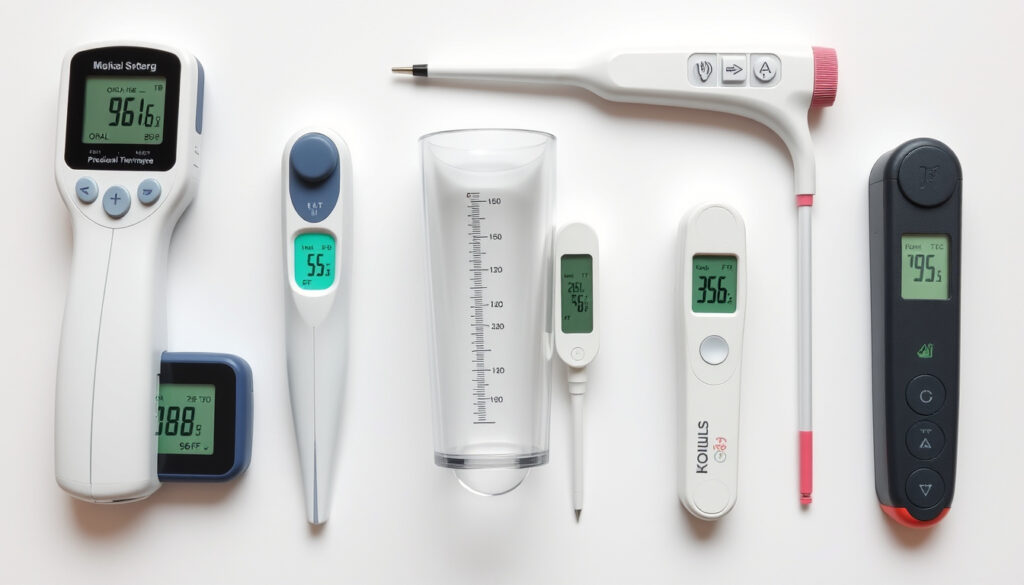
What Is Normal Body Temperature? Ranges for Adults, Kids & More
Forget the 98.6°F you learned in school — modern research puts the average healthy adult temperature closer to 97.9°F, and your personal baseline shifts throughout the day, across age groups, and depending on how you measure. Knowing the real ranges helps you tell normal fluctuation from a genuine fever signal.
Average normal: 98.6°F (37°C) · Adult range: 97°F to 99°F · Fever onset: 100.4°F (38°C)
Quick snapshot
- 98.6°F traces to 1868 data (Stanford Medicine)
- Modern average sits at 97.9°F (Stanford Medicine)
- Adult fever threshold is 100.4°F across all sources (Stanford Medicine)
- Precise “normal” varies person to person
- Ideal baseline without symptoms still debated
- 1868: Wunderlich established 98.6°F standard (Stanford Medicine)
- 2023: Stanford confirmed modern decline to 97.9°F (Stanford Medicine)
- Age-adjusted guidelines gaining traction
- Personal baseline tracking tools emerging
Key temperature benchmarks drawn from clinical literature show how averages and thresholds have shifted from historical standards to current research findings.
| Label | Value |
|---|---|
| Historical average | 98.6°F (37°C) — from Carl Wunderlich’s 1868 study |
| Modern adult range | 97.5°F–98.9°F oral (Medical News Today) |
| Children range | 96.4°F–99.5°F (Medical News Today) |
| Hypothermia | Below 95°F (35°C) — requires attention |
| Fever start | 100.4°F (38°C) — universal threshold |
Is a normal body temperature 36 or 37?
Both figures land in the normal window, depending on how and when you measure. Oral temperatures typically fall between 97.2°F and 98.6°F (36.24°C–37°C), while rectal readings run about 0.5°F to 1°F higher (Healthline). In the morning, a healthy oral reading can dip as low as 36.3°C (97.4°F), then climb to 37.6°C (99.6°F) by late afternoon — a rhythm your body runs on a roughly 24-hour cycle (My Health Alberta).
Typical ranges in Celsius
For most adults, normal oral temperature sits between 36.1°C and 37.2°C, according to MedlinePlus. Rectal and ear measurements tend to run 0.5°C higher, while armpit readings are typically 0.5°C lower. Babies and young children show wider upper limits on rectal thermometry — up to 37.9°C — before the range tightens after age 3 (Healthline).
Factors affecting daily variation
Your core temperature follows a circadian pattern, dipping lowest around 4 a.m. and peaking in the late afternoon or early evening. Physical activity, hormonal cycles, meal times, and even stress can shift your reading by 0.5–1°F on any given day (Nurse Next Door). This is why a single reading rarely tells the full story.
A morning reading of 99°F might signal a low-grade fever for some people, but it could be perfectly normal for you if taken in the afternoon after a workout. Context — time of day, activity level, measurement method — shapes whether a number means anything.
What is the ideal body temperature by age?
Age reshapes the baseline. Younger adults average around 36.69°C, while adults aged 60 and older sit about 0.23°C lower — a difference confirmed by a systematic review of 25 studies (PMC). Harvard Health puts the senior average at 97.7°F, and some adults over 65 can measure as low as 93°F orally without cause for alarm (Healthline).
Babies and kids
Infants under 3 months need immediate evaluation for any reading at or above 100.4°F (38°C) — this is a firm clinical rule, not a guideline (Ubie Health). Once children reach 3 to 10 years, their oral range mirrors adults at 97.0°F–99.0°F (RG Hospitals). Rectal temperatures in toddlers can span 97.9°F to 100.2°F without indicating illness (Healthline).
Adults
For most healthy adults, the range sits between 97°F and 99°F (36.1°C–37.2°C), according to MedlinePlus and Mayo Clinic. The American Academy of Pediatrics and European guidelines both define fever as a temperature exceeding 38.0°C regardless of age (PMC). Adults generally tolerate fevers up to 103°F at home; anything above that warrants professional evaluation.
Seniors over 65
Older adults often run cooler than younger populations, which means the fever threshold can sneak up on caregivers. A temperature that wouldn’t raise flags in a 30-year-old might be significant in someone over 65. The lower baseline also raises hypothermia risk — readings below 95°F (35°C) warrant urgent care in seniors (Harvard Health).
If you’re checking on an aging parent, treat 99.5°F with more caution than you would for yourself. Their “elevated” zone starts lower, and infections in older adults sometimes produce muted or absent fever responses.
Is 37.5 a high temperature?
By strict clinical definitions, 37.5°C (99.5°F) sits in the low-grade fever range for most adults — just below the 38.0°C threshold that major pediatric and internal-medicine bodies use as the universal cutoff (PMC). In practice, whether 37.5°C signals trouble depends heavily on your personal baseline and symptoms.
37.7°C context
A reading of 37.7°C (99.9°F) edges closer to — but still sits below — the fever threshold. If this persists for more than a day or comes with chills, body aches, or fatigue, it’s worth monitoring closely. Some sources note that individual baselines can run as high as 98.2°F without illness (Stanford Medicine), which means 99.9°F might be only 1.7°F above your personal normal.
When it signals fever
Fever isn’t just about the number — it’s about the context. The AAP and European guidelines define fever as >38.0°C measured by any method, but Healthline adds a useful nuance: a reading 2°F above your personal normal also counts as fever, regardless of the absolute value. That means if your baseline runs 97.0°F, a 99.0°F reading could qualify.
Adult thresholds
For adults, the clinical hierarchy runs: low-grade fever from 99.1°F–100.4°F, moderate fever up to 103°F, and high fever above 103.1°F (Medical News Today, Ubie Health). Most adults can manage a moderate fever at home with fluids and rest; persistent readings above 103°F or accompanying confusion, severe headache, or rash need prompt medical attention.
In adults, a sustained fever above 103°F can strain the cardiovascular system and requires medical evaluation. Do not wait it out if accompanied by chest pain, shortness of breath, or altered mental status — call a provider immediately.
Is a temperature of 35.5 ok?
Readings below 35.5°C (95.9°F) fall outside the healthy range and may indicate hypothermia or an underlying health issue. This is especially true if the low reading comes with shivering, confusion, slurred speech, or unusual fatigue.
35.4–35.5°C risks
At these levels, the body is working to maintain core temperature, and physiological stress begins. Causes can include prolonged cold exposure, metabolic disorders, sepsis, or certain medications. For seniors, even mild hypothermia (35.0°C–36.0°C) is associated with increased mortality in hospitalized settings (Harvard Health).
Hypothermia signs
Mild hypothermia (32°C–35°C) shows as intense shivering, poor coordination, and sluggish responses. Moderate to severe hypothermia (below 32°C) causes shivering to stop — a dangerous sign — along with confusion, a slow pulse, and eventually loss of consciousness.
When it’s an emergency
Any reading below 35.0°C (95°F) in a symptomatic person should prompt emergency care. Infants under 3 months who feel cool to the touch or register below normal on a rectal thermometer need immediate pediatric evaluation. For otherwise healthy adults, a single slightly low reading without symptoms may be normal variation — but repeated low readings warrant a doctor’s visit.
Low body temperature gets far less attention than fever, but in hospitalized seniors it carries a mortality signal that clinicians take seriously. Don’t dismiss a cold reading if the person seems confused, unusually drowsy, or isn’t shivering — act on the symptoms, not just the number.
What is the normal body temperature in Fahrenheit?
The most widely recognized figure — 98.6°F — traces to Carl Wunderlich’s 1868 study, which measured axillary temperatures in over 25,000 patients (Stanford Medicine). Modern researchers using oral and other methods have revised that average downward: a 2023 Stanford analysis found the contemporary average across healthy adults is 97.9°F, with a range of 97.3°F to 98.2°F.
Celsius vs Fahrenheit conversion
To convert: subtract 32, then multiply by 5/9. So 98.6°F equals 37.0°C, 99°F equals 37.2°C, and 100.4°F equals 38.0°C. The adult normal range of 97°F–99°F converts neatly to 36.1°C–37.2°C. For quick mental math, remember that 37°C is 98.6°F — a useful anchor.
Ranges for adults and kids
Adults: 97°F–99°F normal; 100.4°F onward signals fever. Children: 95.9°F–99.5°F normal; rectal readings can reach 100.2°F without illness (Healthline). The fever threshold is identical at 100.4°F for both age groups, though children tend to run higher fevers — tolerated up to 40°C short-term — without the same risk profile as in infants (My Health Alberta).
The 98.6°F standard that hospitals and households still cite today comes from a time before thermometers were standardized, when measuring sites and methods differed wildly from modern practice. The number isn’t wrong — it’s just from a different era of human physiology.
The pattern: what we call “normal” keeps shifting as measurement methods improve, which means your personal baseline matters more than any single textbook figure.
Confirmed facts
- Average 98.6°F/37°C widely cited across medical literature
- Adult normal range: 97°F–99°F confirmed by MedlinePlus, Mayo Clinic
- Fever threshold 100.4°F universal across sources
- Modern average 97.9°F documented by Stanford Medicine (2023)
What’s unclear
- Precise “normal” for any given individual without symptoms
- Optimal tracking method for personal baseline establishment
Stanford Medicine
The often-cited standard of 98.6°F stems from data published in 1868 by Carl Wunderlich, who measured axillary temperatures in more than 25,000 patients. Contemporary research suggests the modern average is closer to 97.9°F.
Harvard Health
Normal body temperature is not a single number, but rather a range of temperatures. What one person experiences as normal can vary by half a degree or more across the day.
For anyone tracking a child’s fever or monitoring an aging parent’s health, the stakes are practical: a wrong call on a number can mean unnecessary worry or a missed signal. Knowing your personal baseline — and adjusting it for age and measurement method — transforms a single thermometer reading from a trivia fact into a useful health tool.
What is normal body temperature for women?
Women’s core temperatures can run 0.3°C higher than men’s during the second half of the menstrual cycle due to progesterone. Pregnancy also raises baseline slightly. Beyond these shifts, women’s normal range overlaps with the adult standard of 97°F–99°F.
Is 38 normal body temperature?
No — 38°C (100.4°F) is the universal fever threshold for all ages according to the AAP, CDC, and European guidelines. A reading at or above this should be monitored, and for infants under 3 months, any fever at this level warrants immediate medical evaluation.
What is normal body temperature for kids?
Children’s oral normal range is 97°F–99°F (36.1°C–37.2°C), though rectal measurements in toddlers commonly run up to 100.2°F without illness. Fever in children is defined the same as adults: 100.4°F (38°C) or higher.
Is 100 normal body temperature?
A reading of 100°F (37.8°C) sits just below the clinical fever threshold of 100.4°F, placing it in the low-grade fever range. Whether it warrants concern depends on symptoms and the person’s baseline — for a child who appears well, a brief 100°F reading after play may resolve without intervention.
What illnesses cause low body temperature?
Conditions that lower core temperature include hypothyroidism, sepsis, hypoglycemia, Addison’s disease, and severe infections. Certain medications — particularly sedatives and blood pressure drugs — can also suppress temperature. In seniors, even mild hypothermia is associated with worse outcomes in hospital settings.
What is fever body temperature?
Fever is defined as a body temperature at or above 100.4°F (38°C) for all ages, measured by any method. High fever in adults — above 103°F — generally requires medical attention, especially if accompanied by confusion, rash, or difficulty breathing.
Is 37.7 a high fever for an adult?
No — 37.7°C (99.9°F) falls below the 38°C fever threshold. However, if this reading is notably higher than your personal baseline and accompanied by symptoms like chills, body aches, or fatigue, it may indicate a developing infection worth monitoring for 24–48 hours.
Related reading: red spots on skin that could indicate cancer · how to treat an ingrown toenail
Related coverage: normal temperature for children fördjupar bilden av Normal Temperature for Child – Ranges by Age and Method.
More related posts
 Gortin Glen Forest Park: Trails, Facilities, and Nearby Hikes
 House for Sale Mayo: Find Bargains, Cottages & Land
 Millie Bobby Brown Baby Adoption: Latest Details
 Road Traffic Accident Today: Ireland Updates & Safety Tips
 Irish Soda Bread Recipe: Traditional, Simple & Best (No Yeast)
 Sofia Carson Movies and TV Shows: Full List & Upcoming
 Meaghers Pharmacy Discount Code: 15% Off + Free Voucher
 Marks and Spencer Limerick: Store Info, Hours, Closures