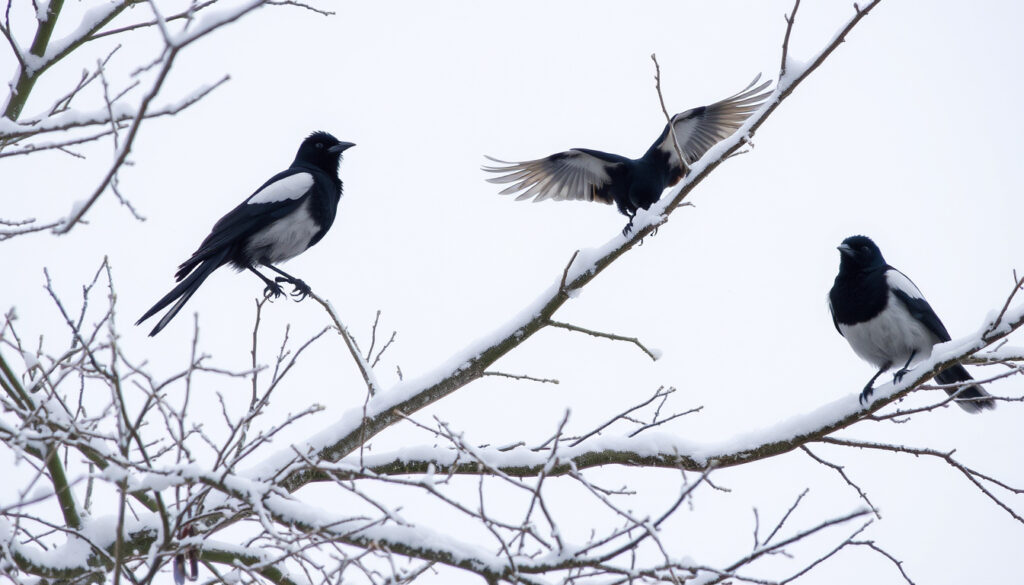
One for Sorrow Two for Joy: Full Magpie Rhyme
There’s a little rhyme that’s stuck in the heads of generations across the British Isles — a simple counting chant that turns ordinary magpies into messengers of fate, but its origins date back to medieval beliefs about birds and fortune. The earliest known printed version dates back to 1846.
Verses recorded in the earliest known print: 1846 ·
Maximum magpies counted in the most extended rhyme version: 20 ·
Common number of magpies said to bring sorrow: 1 ·
Number of magpies said to bring joy: 2 ·
Number of magpies associated with a secret never to be told: 7 ·
Number of magpies associated with a wish: 8
Quick snapshot
- First printed in 1846 by James Orchard Halliwell (Bird Spot, specialist wildlife site)
- Standard version runs seven lines (Birdfact, ornithology resource)
- Rhyme linked to ornithomancy (bird omen interpretation) (Bird Spot) (Bird Spot, specialist wildlife site)
- Exact origin of the superstition is unknown, though likely medieval (Icy Sedgwick, folklore historian)
- Whether the rhyme was originally for children or adults is debated (Bird Spot) (Icy Sedgwick, folklore historian)
- The full 20-line version has multiple conflicting sources (RTÉ Brainstorm, Irish public media)
- c. 1780: Earliest known written version recorded in Lincolnshire (Icy Sedgwick)
- 1846: First printed in Halliwell’s The Nursery Rhymes of England (Bird Spot)
- 2003: The Innocence Mission release song “One for Sorrow, Two for Joy”
- 2019: Children’s book One for Sorrow, Two for Joy published
- Regional variations continue to be collected; no definitive canonical list exists (RTÉ Brainstorm)
- Wikis and folklore sites increasingly document extended versions up to 20 magpies
Four key facts paint the picture: the rhyme’s first known print, its length, the bird species involved, and its cultural roots.
| Fact | Detail |
|---|---|
| First known printed version | 1846 in The Nursery Rhymes of England by James Orchard Halliwell (Bird Spot) |
| Standard version length | 7 lines (78 words) (Birdfact) |
| Magpie species referenced | Eurasian magpie (Pica pica) (Bird Spot) |
| Cultural origin | British Isles, with variations in Scotland and Ireland (RTÉ Brainstorm) |
What is the full magpie rhyme?
How does the standard version read?
- The most widely repeated version stops at seven magpies and reads: “One for sorrow, Two for joy, Three for a girl, Four for a boy, Five for silver, Six for gold, Seven for a secret, never to be told.” (Birdfact, ornithology resource)
- This version was popularised by James Orchard Halliwell’s 1846 collection (Bird Spot, specialist wildlife site)
What are the most common numbered lines?
Numbers 1–7 are firmly established. But the tradition extends well beyond seven. The earliest known example from c. 1780 in Lincolnshire used a different set: “One for sorrow, two for mirth, / Three for a wedding, four for a death.” (Icy Sedgwick, folklore historian)
The variation illustrates the fluidity of folk tradition.
Why do they say One for sorrow and two for joy?
What is the superstition behind counting magpies?
The rhyme is based on British folklore that the number of magpies seen predicts good or bad fortune. The superstition almost certainly stems from ornithomancy — the practice of interpreting omens from bird behaviour (Bird Spot).
A lone magpie signals sorrow because the birds mate for life; seeing one alone suggests a lost partner. But that logic only works if you accept the bird as a symbol of fidelity — a link early folklorists embraced.
How many magpies are considered lucky or unlucky?
The rhyme assigns each count a specific outcome. Two magpies bring joy, seven bring a secret. The full omen tradition goes far deeper: some versions run to 20 birds, assigning each number a fate.
| Number | Meaning (standard) | Source |
|---|---|---|
| 1 | Sorrow | Poem Analysis, literary resource |
| 2 | Joy | Poem Analysis |
| 3 | A girl (in some versions) | Birdfact |
| 4 | A boy (or death in older variants) | Icy Sedgwick |
| 5 | Silver | Birdfact |
| 6 | Gold | Birdfact |
| 7 | A secret never to be told | Birdfact |
The pattern: numbers 1–4 carry the heaviest omens — sorrow, joy, life, death. After that the rhyme shifts to material rewards (silver, gold) before ending with a sealed secret.
Magpie rhyme up to 20
What is the saying for 9 magpies?
- Eight for a wish, Nine for a kiss, Ten for a bird you must not miss, Eleven for health, Twelve for wealth. (Birdfact)
What is the saying for 10 magpies?
“Ten for a bird you must not miss” is the most commonly cited line. Some extended versions add: “Thirteen for a curse, Fourteen for a hearse, Fifteen for a wedding, Sixteen for a birth, Seventeen for a grave, Eighteen for a dance, Nineteen for a chance, Twenty for a trance.” (RTÉ Brainstorm, Irish public media)
What is the saying for 12 magpies?
“Twelve for wealth” is the standard line. But these higher numbers lack the same historical backing as the initial seven. Folklorists caution that later extensions were likely invented by Victorian collectors to fill out the sequence (Icy Sedgwick, folklore historian).
The extended lines show how collectors shaped the rhyme for completeness.
What is the darkest nursery rhyme of all time?
Does the magpie rhyme have a dark meaning?
The magpie rhyme is often mentioned in discussions of dark nursery rhymes due to its theme of death and omens. The early variant from c. 1780 directly mentions death (“Four for a death”), and the ritual of saluting a lone magpie to ward off bad luck adds a layer of superstition that borders on morbidity (Bird Spot).
What makes the rhyme dark isn’t violence — it’s uncertainty. You never know whether today’s magpie count brings sorrow or joy, and the rhyme offers no control, only awareness.
How does “One for Sorrow” compare to other grim rhymes?
Compared to rhymes like “Ring a Ring o’ Roses” (often linked to plague) or “London Bridge Is Falling Down” (destruction), the magpie rhyme is less about catastrophe and more about private superstition. It doesn’t describe an event; it prescribes an interpretation of everyday life. That psychological weight — the burden of reading omens — keeps it in conversations about unsettling nursery verses (RTÉ Brainstorm).
What is the rhyme for magpies at funerals?
Is there a specific magpie rhyme for mourning?
Variations of the rhyme include lines referencing funerals or sorrow directly, but no standard version is exclusively for funerals. The closest is the c. 1780 variant ending with “death,” or later lines like “Fourteen for a hearse.” (Icy Sedgwick)
How does the rhyme connect magpies to death?
Magpies have long associations with bad luck, negativity, and ill omens (RTÉ Brainstorm). Their black-and-white plumage, their habit of gathering at carrion, and their clever, sometimes aggressive behaviour all fed into a reputation as death’s messengers. The rhyme simply codified that folk belief into a counting chant. The implication: funerals are not the rhyme’s focus, but death runs through its DNA. Anyone using it at a mourning gathering is tapping into a much older, darker vein of folklore.
Timeline of the magpie rhyme
- Medieval period: Magpie superstitions believed to originate from Scandinavian and Celtic folklore. (Bird Spot)
- c. 1780: Earliest known written version recorded in Lincolnshire: “One for sorrow, two for mirth, Three for a wedding, four for a death.” (Icy Sedgwick)
- 1846: First printed record in James Orchard Halliwell’s The Nursery Rhymes of England. (Bird Spot)
- 19th century: Variations spread across Britain, Ireland, and into North America. (Icy Sedgwick)
- 2003: The Innocence Mission release song “One for Sorrow, Two for Joy”.
- 2019: Publication of the children’s book One for Sorrow, Two for Joy by Marie-Claire Amuah.
The timeline shows how a folk omen became a printed nursery rhyme.
Clarity check: what’s confirmed and what’s unclear
Confirmed facts
- The first printed version appeared in 1846. (Bird Spot)
- The rhyme’s earliest known form is attributed to James Orchard Halliwell. (Bird Spot)
- The rhyme is based on counting Eurasian magpies. (Birdfact)
What’s unclear
- The exact origin of the superstition is unknown, though likely medieval. (Icy Sedgwick)
- Whether the rhyme was originally for children or adults is debated. (Bird Spot)
- The full 20-line version has multiple conflicting sources. (RTÉ Brainstorm)
These lists separate what we know from what remains uncertain.
What the folklorists said
“One for sorrow: Two for mirth: Three for a wedding: Four for death.”
— James Orchard Halliwell, The Nursery Rhymes of England (1846) (Bird Spot)
“The magpie rhyme is a survival of the ancient practice of ornithomancy — reading the future by observing birds.”
— Iona and Peter Opie, The Oxford Dictionary of Nursery Rhymes (cited by Icy Sedgwick)
“In some places ‘death’ is replaced by ‘birth,’ showing how fluid the tradition really is.”
— Icy Sedgwick, folklore historian (Icy Sedgwick)
“The rhyme has many versions across diverse cultures; the unifying thread is the magpie as a bearer of omens.”
— RTÉ Brainstorm, Irish public media analysis (RTÉ Brainstorm)
The magpie rhyme is not one poem — it’s a living folk tradition that has shifted every generation. For the modern reader, the choice is clear: you can stick with the clean seven-line version most people know, or you can dive into the sprawling 20-line expansions that Victorian collectors and online folklore fans have assembled. Either way, the rhyme’s core message endures: two magpies mean joy, one means sorrow, and the rest is up to the telling.
nigelmusic.wordpress.com, blog.gardenwildlifedirect.co.uk, reddit.com, reddit.com, en.wikipedia.org, youtube.com, facebook.com
Frequently asked questions
What does “One for sorrow” mean in the magpie rhyme?
It means that seeing a lone magpie is considered an omen of sadness or misfortune. (Poem Analysis)
How many magpies bring good luck?
Two magpies bring joy; higher numbers such as six (gold) and eight (wish) are also considered lucky. (Birdfact)
Is the magpie rhyme still used today?
Yes, especially in the UK and Ireland, where people still count and salute magpies. (RTÉ Brainstorm)
What magpie count is associated with a funeral?
Fourteen for a hearse (in extended versions) and four for a death (in the earliest known variant). (Icy Sedgwick)
Can the rhyme be used for other birds?
It can be adapted — some versions substitute crows or jackdaws — but the magpie is the traditional focal bird. (Birdfact)
Where did the superstition of counting magpies come from?
Likely from medieval ornithomancy, with roots in Scandinavian and Celtic folklore. (Bird Spot)
What is the complete “One for Sorrow” rhyme up to 20?
The most common 20-line version is: one sorrow, two joy, three girl, four boy, five silver, six gold, seven secret, eight wish, nine kiss, ten bird, eleven health, twelve wealth, thirteen curse, fourteen hearse, fifteen wedding, sixteen birth, seventeen grave, eighteen dance, nineteen chance, twenty trance. (RTÉ Brainstorm)
Does the rhyme vary by region?
Yes, strongly. Scottish variants often replace “death” with “birth,” and Irish versions sometimes add local omens. (Icy Sedgwick)
More related posts
 Julio Cesar Chavez Jr: Record, Deportation, Net Worth 2026
 Premier League Summer Series Standings 2025 – Man Utd Top
 House for Sale Mayo: Find Bargains, Cottages & Land
 Today’s Horse Racing Results: UK, Ireland & Fast Updates
 Premier League Darts Table 2026: Live Standings & Results
 Lily Allen New Album West End Girl: Songs, Split & OnlyFans
 Cork to Killarney Train: Timetable, Prices & Tickets
 Borderline Personality Disorder Symptoms: 9 Key Signs