What Is a Scrambler Bike? Irish Law & History
If you’ve ever heard the thin buzz of a small motorcycle cutting through a park or greenway in Ireland, you’ve probably wondered what exactly a scrambler bike is and why it causes such a stir. The answer sits at the intersection of off-road engineering, Irish road traffic law, and a recent wave of enforcement powers that changed how these machines are treated. Here’s what you need to know about their design, their legal status, and what the rules mean for riders and communities.
Road-legal scramblers registered in Ireland: Fewer than 500 (est. 2025) ·
Typical engine size for adult scramblers: 250cc to 500cc ·
Seat height range: 830–900 mm ·
Average price on DoneDeal: €1,500–€4,000
Quick snapshot
- Off‑road riding on loose terrain (Department of Transport, Ireland)
- Not intended for tarmac roads (Department of Transport, Ireland)
- Versatile for fire roads and singletrack (Department of Transport, Ireland)
- High‑mounted exhaust system (Department of Transport, Ireland)
- Knobby tyres for traction (Department of Transport, Ireland)
- Raised suspension (Department of Transport, Ireland)
- Upright seating position (Department of Transport, Ireland)
- Illegal on public roads without registration (Department of Transport, Ireland)
- Seizable by Garda under Grace’s Law (Department of Transport, Ireland)
- Requires licence, tax, insurance for road use (Department of Transport, Ireland)
- Second‑hand: €1,500–€4,000
- New road‑legal models: €5,000–€12,000
- Price varies by engine size and brand
Five key facts summarise the scrambler’s place in Ireland: its definition, origin, legality, enforcement, and common engine size point to a vehicle that lives in a grey area between recreation and regulation.
| Fact | Detail |
|---|---|
| Definition | A motorcycle designed for off‑road use on soft loose terrain, generally not on tarmac (Department of Transport, Ireland) |
| Origin | British “scrambles” off‑road races from the 1950s (RTÉ News) |
| Road legality in Ireland | Illegal to use on public roads unless registered, taxed, insured, and NCT‑compliant (Department of Transport, Ireland, 2025) |
| Garda enforcement | Garda can seize unregistered scramblers; Grace’s Law imposes driving bans for Garda chases (BBC News) |
| Common engine size | 250cc to 500cc for adults |
| Seat height | 830–900 mm |
| Average price (second‑hand) | €1,500–€4,000 |
What is the purpose of scrambler bikes?
Definition and design features
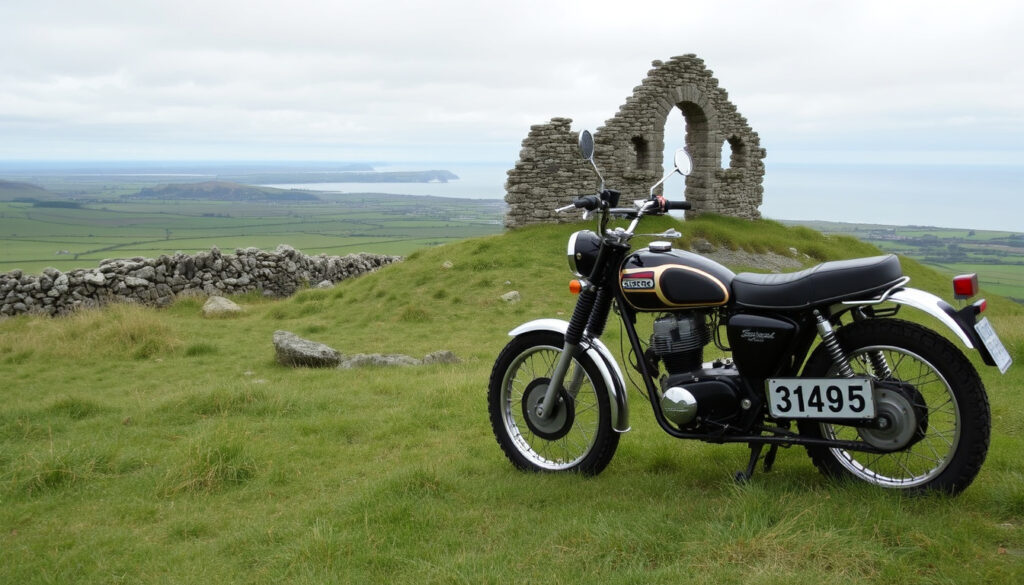
A scrambler is built for loose, unpaved terrain. The Irish government treats it as an “off‑road motorcycle” alongside quad bikes (Department of Transport, Ireland). Its raised suspension, knobby tyres, and high exhaust let it cross fire roads, dirt paths, and mild singletrack without choking on water or mud. The upright seating posture gives the rider control at low speeds over uneven ground.
On‑road vs off‑road capability
Scramblers are not designed for tarmac. Their tyres and suspension compromise highway stability and braking. Many are sold without mirrors, lights, or speedometers – all features required for road‑legal status in Ireland. While some factory models (e.g., Triumph Street Scrambler) are type‑approved for mixed use, the vast majority of bikes sold as scramblers are pure off‑road machines.
A scrambler’s off‑road agility is the very feature that makes it unsafe – and illegal – on public roads unless carefully registered and modified. Riders choosing a pure off‑road model must accept they can never legally take it on the street.
The implication: riders must choose a scrambler based on intended use, as road legality imposes strict requirements.
Why are they called scramblers?
Origin of the name in British off‑road racing
The term comes from “scrambles” – a format of off‑road motorcycle racing that emerged in Britain in the 1950s (RTÉ News, Irish public broadcaster, referencing historical context). Riders would “scramble” over rough, closed‑course circuits, and the bikes that specialised for those events became known as scramblers. By the 1960s, manufacturers such as BSA and Triumph sold factory scrambler editions.
Evolution from 1950s desert racing
In the U.S., a parallel tradition of desert racing produced the “desert sled” – bikes with long‑travel suspension and knobby tyres. The two lineages converged in the 1970s, but the British “scrambles” name stuck in Ireland and the UK. Today the label covers a wide spectrum from retro‑styled street bikes to dedicated competition machines.
What this means: the term ‘scrambler’ is cultural, not legal, so Irish courts look to the vehicle’s off‑road design rather than its label.
Are scramblers illegal in Ireland?
Legal definition under Irish road traffic law
Under Irish law, a scrambler is not a separate category; it falls under “off‑road motorcycle.” Using one on a public road has been illegal since July 2023 (Department of Transport, Ireland). The April 2026 regulations extended the ban to all public places – parks, green areas, beaches, waste ground – unless the vehicle is on private land with the owner’s written consent (Irish Statute Book).
Requirements for road use: licence, tax, insurance, NCT
To use a scrambler on the road legally, it must be registered with the Revenue Commissioners, taxed, insured, and have a valid NCT (National Car Test). The rider must hold a Category A1, A2, or A driving licence. In practice, few pure scramblers meet these requirements because they lack the necessary lighting, mirrors, and type approval.
- Scramblers used only off‑road on private land are not illegal (Department of Transport, Ireland).
- Using a scrambler in any public place without landowner consent is an offence (Irish Statute Book).
- Garda can seize unregistered scramblers and, under Grace’s Law, impose driving bans for evading Garda (Department of Transport, Ireland).
The 2026 regulations closed a loophole: before that, riders could argue they were not on a “road.” Now the ban covers virtually every public space. Riders who buy a scrambler for recreational use must have written permission from a landowner – and a way to transport the bike without riding it on public roads.
The pattern: Irish law has progressively closed loopholes, making it increasingly difficult to legally operate a scrambler outside private land.
Do you need a licence for a scrambler bike?
Licence categories for off‑road vs road use
If you ride a scrambler only on private land, you do not need a driving licence (Department of Transport, Ireland). But if you take it onto a public road – even briefly – you need a full motorcycle licence. The category depends on the bike’s power output and engine size: A1 for 11–35 kW (typically up to 250cc), A2 for up to 35 kW (up to 500cc), and A for unrestricted.
Age and training requirements
For a Category A1 licence, you must be at least 16 years old, complete an IBT (Initial Basic Training) course, and pass the driving test. For A2, you must be 17 or older. No licence is required for off‑road use on private land, but the bike must not be used in any public place.
The catch: for most scrambler owners, the licence requirement is irrelevant because their bikes cannot be used on roads at all.
What does a scrambler bike look like?
Key visual features: high exhaust, knobby tyres, raised suspension
Scramblers are immediately identifiable by their high‑mounted exhaust pipe that follows the line of the rear wheel – a design meant to keep the silencer clear of water when crossing streams. Knobby tyres, long‑travel suspension (often 200+ mm), and a flat, narrow seat complete the silhouette. The handlebars are wide and high, forcing an upright posture.
Common brands and models: Honda, Triumph, Ducati
Factory scramblers include the Honda Scrambler 400, Triumph Street Scrambler 900, and Ducati Scrambler 800. These are road‑legal versions built for mixed use. Most mass‑market “off‑road” scramblers sold in Ireland, however, are unbranded or Chinese‑imported models with no type approval.
The takeaway: visual identification helps distinguish road‑legal factory models from off‑road‑only machines, but the legal status depends on registration, not looks.
Timeline signal
First scrambles races held in Britain on closed‑off‑road circuits – the origin of the name. (RTÉ News)
Manufacturers began producing factory scrambler models for public sale. (RTÉ News)
Irish government bans scramblers on public roads; Garda get seizure powers (Department of Transport, Ireland).
Grace’s Law enacted after a Garda chase involving a scrambler rider (BBC News).
New regulations extend the ban to all public places, with exceptions for private land (Irish Statute Book; RTÉ News).
Clarity section
Confirmed facts
- Scramblers are designed for off‑road use on loose terrain (Department of Transport, Ireland).
- Using an unregistered scrambler on Irish public roads is illegal (Department of Transport, Ireland).
- Garda have powers to seize unregistered scramblers (Department of Transport, Ireland).
- Grace’s Law allows criminal penalties for evading Garda on a scrambler (BBC News).
What’s unclear
- Exact number of scramblers in Ireland is not tracked centrally.
- Whether a specific scrambler model is road‑legal depends on individual type‑approval.
- The exact number of scramblers in Ireland, both road‑legal and off‑road only, is unknown.
- The impact of the 2026 public‑place ban on scrambler usage patterns has not yet been measured.
The government calls scramblers off‑road motorcycles and bans them from public places, yet it does not centrally track how many exist. That lack of data makes enforcement reactive rather than systematic, leaving communities frustrated by persistent misuse.
Quotes
“The regulations provide additional legal clarity because scramblers were already banned on public roads but were being used in public places such as parks.”
— BBC News, citing a government spokesperson
“Gardaí may request proof of the landowner’s consent or proof that the vehicle is being used on the owner’s land.”
— Irish Statute Book, 2026 Regulations
“Misuse of quads and scramblers has caused significant ongoing issues for local communities, particularly in urban areas.”
— Department of Transport, Ireland, 2025 press release
For Irish riders and communities, the path forward is clear: scramblers must be used only on private land with explicit permission, or risk seizure and prosecution. The law now leaves little room for ambiguity – the trade‑off is between recreational freedom and public safety.
Related reading: Road Traffic Accident Today: Ireland Updates & Safety Tips · Tyre Shop Near Me: Costs, Lifespan & Replacement Guide (2025)
extra.ie, thejournal.ie, gov.ie, bbc.com, thelawblog.in, independent.ie, sdcc.ie, facebook.com
For a detailed look at a popular urban scrambler, the Yamaha PG1 scrambler guide provides comprehensive information on the Yamaha PG1.
Frequently asked questions
What is the difference between a scrambler and a dirt bike?
A scrambler typically has a higher exhaust, more upright seating, and a street‑legal option, while a dirt bike is lighter, has longer suspension travel, and is built solely for competitive off‑road riding.
Can a scrambler be used on the road in Ireland?
Only if it is registered, taxed, insured, NCT‑compliant, and the rider holds the correct licence. Most pure scramblers do not meet these requirements.
How fast can a scrambler bike go?
Top speeds vary by engine size – a 250cc scrambler typically reaches 70–90 km/h off‑road, while larger factory models can exceed 130 km/h on road.
What size scrambler is best for a beginner?
A 125cc to 250cc engine is ideal for beginners, offering manageable power and lower seat heights.
Do scramblers have a street‑legal version?
Yes – several manufacturers sell road‑legal scramblers (e.g., Triumph Street Scrambler, Honda Scrambler 400) with lights, mirrors, and type approval.
What brands make scrambler motorcycles?
Major brands include Triumph, Honda, Ducati, Yamaha, and Royal Enfield. In Ireland, many unbranded imports also flood the market.
How much does it cost to insure a scrambler in Ireland?
Insurance varies widely – from €200 for a low‑power 125cc on a named‑driver policy to over €1,000 for a high‑cc machine with no road experience.
More related posts
 Flight to London from Dublin: Cheap Deals & Tips
 Welfare Payment Boost Budget 2026: Dates & Increases
 How to Make Carbonara Sauce: 5 Ingredients & Common Mistakes
 Is Donald Trump Still Alive? Latest Facts and Updates
 Bank Holiday October 2025: US, Ireland, Philippines Dates
 Car Rental Near Me: Compare Cheap Ireland Rates 2025
 Free Walking Tour Dublin: Pay-What-You-Wish Guide & Tips